length
5,325 words
a few pages a day
~8 min
finished in
3 days
full read
22 min
At Folio's default of ten pages a day, you finish The Scholfield Wool-Carding Machines in about 3 days — roughly 8 minutes of reading each morning.
The opening
the first pages of The Scholfield Wool-Carding Machines, free
[Illustration: Figure 1.--AN ORIGINAL SCHOLFIELD WOOL-CARDING MACHINE, built by Arthur Scholfield or under his immediate direction between 1803 and 1814, as exhibited in the hall of textiles of the U.S. National Museum (cat. no. T11100). The exhibits in this hall are part of those being prepared for the enlarged hall of textiles in the new Museum of History and Technology now under construction. (Smithsonian photo 45396.)]
By Grace L. Rogers
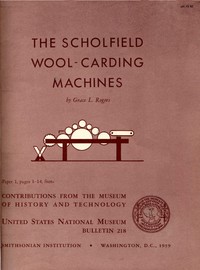
THE SCHOLFIELD WOOL-CARDING MACHINES
_First to appear among the inventions that sparked the industrial revolution in textile making was the flying shuttle, then various devices to spin thread and yarn, and lastly machines to card the raw fibers so they could be spun and woven. Carding is thus the important first step. For processing short-length wool fibers its mechanization proved most difficult to achieve._
_To the United States in 1793 came John and Arthur Scholfield, bringing with them the knowledge of how to build a successful wool-carding machine. From this contribution to the technology of our then infant country developed another new industry._
THE AUTHOR: Grace L. Rogers is curator of textiles, Museum of History and Technology, in the Smithsonian Institution's United States National Museum.
Carding is the necessary preliminary step by which individual short fibers of wool or cotton are separated and cleaned of foreign materials so they can be spun into yarn. The thoroughness of the carding determines the quality of the yarn, while the position in which the carded fibers are laid determines its type. The fibers are laid parallel in order to spin a smooth compact yarn, or they are crossed and intermingled to produce a soft bulky yarn.
Primitive Carding
The earliest method of carding wool was probably one in which, by use of the fingers alone, the tufts were pulled apart, the foreign particles loosened and extracted, and the fibers blended. Fuller's teasels (thistles with hooked points, Dispasacus fullonum), now better known for raising the nap on woven woolens, were also used at a very early date for carding. The teasels were mounted on a pair of small rectangular frames with handles; and from this device developed the familiar small hand card (see fig. 2), measuring about 8 inches by 5 inches, in which card clothing (wire teeth embedded in leather) was mounted on a board with the wire teeth bent and angled toward the handle. The wool was placed on one card and a second card was dragged across it, the two hands pulling away from each other. This action separated the fibers and laid them parallel to the handle, in a thin film. After the fibers had been carded in this way several times, the cards were turned so that the handles were together and once again they were pulled across each other. With the wire teeth now angled in the same direction, the action rolled the carded fibers into a sliver (a loose roll of untwisted fibers) that was the length of the hand card and about the diameter of the finger. This placed the wool fibers crosswise in relation to the length of the sliver, their best position for spinning.[1] Until the mid-18th century hand cards were the only type of implement available for carding.
Keep going from exactly here — Folio remembers your place and serves the next portion tomorrow.
continue reading The Scholfield Wool-Carding MachinesAbout this free edition
The Scholfield Wool-Carding Machines by Grace Rogers Cooper (1924-2004) is free to read in full. Folio serves it in daily portions you can actually finish, tracks your streak and reading position across devices, and reads every page aloud with a built-in narrator. The text comes from Project Gutenberg.
More like The Scholfield Wool-Carding Machines
The Invention of the Sewing Machine
Grace Rogers Cooper
The History of the Peloponnesian War
Folio
The History of the Peloponnesian War
Thucydides
The History of Herodotus
Folio
The History of Herodotus
Herodotus
The Gallic Wars
Folio
The Gallic Wars
Julius Caesar
Anabasis
Folio
Anabasis
Xenophon
The Lives of the Twelve Caesars
Folio
The Lives of the Twelve Caesars
Suetonius
Germania
Folio
Germania
Tacitus

The History of the Decline and Fall of the Roman Empire
Edward Gibbon