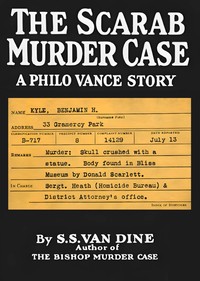
The scarab murder case
free to read
length
78,251 words
a few pages a day
~8 min
finished in
42 days
full read
5h 26m
At Folio's default of ten pages a day, you finish The scarab murder case in about 42 days — roughly 8 minutes of reading each morning.
The opening
the first pages of The scarab murder case, free
Philo Vance was drawn into the Scarab murder case by sheer coincidence, although there is little doubt that John F.-X. Markham--New York’s District Attorney--would sooner or later have enlisted his services. But it is problematic if even Vance, with his fine analytic mind and his remarkable flair for the subtleties of human psychology, could have solved that bizarre and astounding murder if he had not been the first observer on the scene; for, in the end, he was able to put his finger on the guilty person only because of the topsy-turvy clews that had met his eye during his initial inspection.
Those clews--highly misleading from the materialistic point of view--eventually gave him the key to the murderer’s mentality and thus enabled him to elucidate one of the most complicated and incredible criminal problems in modern police history.
The brutal and fantastic murder of that old philanthropist and art patron, Benjamin H. Kyle, became known as the Scarab murder case almost immediately, as a result of the fact that it had taken place in a famous Egyptologist’s private museum and had centred about a rare blue scarabæus that had been found beside the mutilated body of the victim.
This ancient and valuable seal, inscribed with the names of one of the early Pharaohs (whose mummy had, by the way, not been found at the time), constituted the basis on which Vance reared his astonishing structure of evidence. The scarab, from the police point of view, was merely an incidental piece of evidence that pointed somewhat obviously toward its owner; but this easy and specious explanation did not appeal to Vance.
“Murderers,” he remarked to Sergeant Ernest Heath, “do not ordinarily insert their visitin’ cards in the shirt bosoms of their victims. And while the discovery of the lapis-lazuli beetle is most interestin’ from both the psychological and evidential standpoints, we must not be too optimistic and jump to conclusions. The most important question in this pseudo-mystical murder is why--and how--the murderer left that archæological specimen beside the defunct body. Once we find the reason for that amazin’ action, we’ll hit upon the secret of the crime itself.”
The doughty Sergeant had sniffed at Vance’s suggestion and had ridiculed his scepticism; but before another day had passed he generously admitted that Vance had been right, and that the murder had not been so simple as it had appeared at first view.
As I have said, a coincidence brought Vance into the case before the police were notified. An acquaintance of his had discovered the slain body of old Mr. Kyle, and had immediately come to him with the gruesome news.
It happened on the morning of Friday, July 13th. Vance had just finished a late breakfast in the roof-garden of his apartment in East Thirty-eighth Street, and had returned to the library to continue his translation of the Menander fragments found in the Egyptian papyri during the early years of the present century, when Currie--his valet and majordomo--shuffled into the room and announced with an air of discreet apology:
“Mr. Donald Scarlett has just arrived, sir, in a state of distressing excitement, and asks that you hasten to receive him.”
Vance looked up from his work with an expression of boredom.
“Scarlett, eh? Very annoyin’.… And why should he call on me when excited? I infinitely prefer calm people.… Did you offer him a brandy-and-soda--or some triple bromides?”
“I took the liberty of placing a service of Courvoisier brandy before him,” explained Currie. “I recall that Mr. Scarlett has a weakness for Napoleon’s cognac.”
Keep going from exactly here — Folio remembers your place and serves the next portion tomorrow.
continue reading The scarab murder caseAbout this free edition
The scarab murder case by S. S. Van Dine (1888-1939) is free to read in full. Folio serves it in daily portions you can actually finish, tracks your streak and reading position across devices, and reads every page aloud with a built-in narrator. The text comes from Project Gutenberg.
More like The scarab murder case

The Benson Murder Case
S. S. Van Dine
The "Canary" murder case
S. S. Van Dine

The Greene murder case
S. S. Van Dine

The Bishop murder case
S. S. Van Dine
The Adventures of Sherlock Holmes
Arthur Conan Doyle
The Hound of the Baskervilles
Arthur Conan Doyle
A Study in Scarlet
Folio
A Study in Scarlet
Arthur Conan Doyle
The Sign of the Four
Arthur Conan Doyle