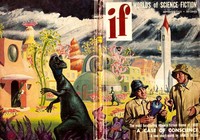
length
4,177 words
a few pages a day
~8 min
finished in
3 days
full read
17 min
At Folio's default of ten pages a day, you finish The Romantic Analogue in about 3 days — roughly 8 minutes of reading each morning.
The opening
the first pages of The Romantic Analogue, free
Norm Venner's fancy was pretty well fixed on thoughts of electronic calculators--until the invention started making passes at the inventor!
* * * * *
Mathematicians are just like people: old, young, fat, thin, male, female. This one was male, thirty-five, with steady brown eyes and a nice smile when he remembered to use it. His name was Norman Venner, and besides being a mathematical whiz generally, he had designed and built an electronic brain, or calculator, which was in some ways smarter than himself--and a lot less diffident.
Electronic calculators are invariably given acronymic names such as BINAC, SEAC, and MANIAC, and nine out of ten of them are of the digital type. This is a nice way of saying that they count on their fingers. They're nearly as big as yachts, and cost more, but can calculate a million times faster than any human.
Norm's machine was of the analogue type, which is less flexible, less complex, and vastly smaller and cheaper. He called it the ICWEA (ICK-wee-ah), which stood for "I Can Work 'Em All!" It could, too! It was especially good at deriving equations from curves, which was really something.
Charley Oglethorpe burst into the office one morning, catching Norm in a brown study. "Hi, Genius. How is she perking now?"
"All right, except the pen skips a little sometimes and makes a messy curve."
"Have to damp that arm better. When can I have her to work on?"
"Soon as I finish these Mugu problems."
Charley stared at him.
"Mugu. Guided-missile center. It's nice business if we can get it--the digitals are all booked up months ahead, and the particular type of problem they send us is right up our alley."
[Illustration]
"I thought you were kidding me, like that Boolean Algebra stuff."
"Wasn't kidding then, either."
"I'll stick to instrument-making, thanks. You math guys never have any fun."
Norm shrugged, turned to the telephone, and called an extension.
"Hermosa." It was a rich, pleasant voice.
"Vic? How about the rest of the Mugu cards? Ready yet?"
"I'll send them up right away. Just finished them."
"Who was that?" Charley inquired.
"Vic Hermosa. Smart boy."
Charley smiled a little.
* * * * *
There was a knock at the door.
"Come in," Norm called. The door opened, and a small, neat girl entered. Her long bob was dark and silky, but windblown. She tossed her head and her hair settled into place, as if she had just brushed it. She extended a pack of punched cards.
"Thank you," Norm said, gravely.
The girl looked up at him suddenly, and he stepped back a little. She had surprising, deep-violet eyes, and their glance seemed to have a tangible impact. She nodded grave acknowledgment and left.
"Damn it, I wish I could do that!" Norm complained.
"Make goo-goo eyes?"
"No. Shake my head so my hair would automatically be combed like hers. I've been fighting this cowlick ever since I've been a kid--stocking caps, gunk, the works. Still got it. And the part moves around and I have to hunt for it."
"Know who she is?"
"Nope. Clerk, messenger, I guess. They're always hiring new ones."
"Doesn't she ever speak?"
"Of course she--come to think of it, I've never heard her. Must say it's a relief after the usual yackety-yack. Haven't anything to talk to her about, anyway. She's just a child."
"A pretty one, though."
"Yes, she is."
Keep going from exactly here — Folio remembers your place and serves the next portion tomorrow.
continue reading The Romantic AnalogueAbout this free edition
The Romantic Analogue by W. W. Skupeldyckle is free to read in full. Folio serves it in daily portions you can actually finish, tracks your streak and reading position across devices, and reads every page aloud with a built-in narrator. The text comes from Project Gutenberg.
More like The Romantic Analogue
The Time Machine
H. G. Wells

The War of the Worlds
H. G. Wells
The Invisible Man
H. G. Wells

The Island of Doctor Moreau
H. G. Wells
The First Men in the Moon
H. G. Wells
The Sleeper Awakes
Folio
The Sleeper Awakes
H. G. Wells
The Food of the Gods and How It Came to Earth
Folio
The Food of the Gods and How It Came to Earth
H. G. Wells

Frankenstein
Mary Shelley