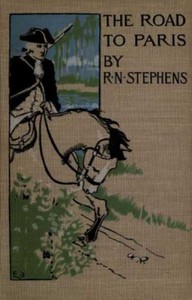
length
128,447 words
a few pages a day
~8 min
finished in
68 days
full read
8h 55m
At Folio's default of ten pages a day, you finish The Road to Paris in about 68 days — roughly 8 minutes of reading each morning.
The opening
the first pages of The Road to Paris, free
"With our company of riflemen that marched in Arnold's army through the Maine wilderness to attack Quebec, there was a sergeant's wife, a large and sturdy woman, no common camp-follower, but decent and respected, who one day, when the troops started to wade through a freezing pond, of which they broke the thin ice coating with the butts of their guns, calmly lifted her skirts above her waist and strode in, and so kept the greater part of her clothes dry in crossing. Not a man of us made a jest, or even grinned, so natural was her action in the circumstances. I have often used this instance to show that what the world calls modesty is a matter of time and place, and I now hold that too much modesty is out of time and place when a man who has had more than a fair share of remarkable experiences undertakes a true relation of the extraordinary adventures that have befallen him. So, if the narrative on which I am setting out be marred by any affectation, it will not be the affectation of modesty.
"When I was a boy in our valley behind the Blue Mountains of Pennsylvania, I used to read the 'True Travels, Adventures, and Observations of Captain John Smith, in Europe, Asia, Africa, and America, from 1593 to 1629,' and wonder whether I should ever have any travels or adventures of my own to make a book of. When, afterwards, I did go a travelling, and adventures did come thick and fast upon me, I was too much engrossed in the travels and adventures themselves to give a thought as to what matter they might be for narration. Not till this breathing-place came in my life, did my boyhood dreams return to my mind, and did I realize that my part in battle and imprisonment, danger and escape, love and intrigue, would make a book that might be worth fireside reading. That book I now begin, and shall probably finish it if I be not interrupted by untimely death or by some new call to scenes of enterprise and turmoil,--for it is no retired veteran, but a man early in his twenties, that here tries whether with pen and ink he can make as fair a show as he has already made with implements less peaceful."
The foregoing lines constitute the first two paragraphs of a book entitled "The Travels and Adventures of Richard Wetheral, in America, England, France, and Germany, in the years 1775, 1776, 1777, and 1778," of which it happens, by strange circumstance, that I possess the only copy. The title-page shows that it was published by (or "printed for") J. Robson, Bookseller, in New Bond Street, London, in 1785. The three brown 16mo volumes first caught my glance when they lay with a heap of ragged books on a board before a second-hand shop in Twenty-sixth Street, there being attached to the board a weather-beaten square of pasteboard, bearing the legend, "Your choice for ten cents." Not until I had paid the dealer thirty cents and separated the three volumes forever from their musty companions, which were mostly of a theological character, did I discover, by parting a blank leaf from the adjacent cover, to which it had long been sticking, that the book was a treasure, for which the dealer would have charged me as many dollars as I had paid cents, had he anticipated my discovery. The long-concealed page bore on its brown-spotted surface an inscription, in eighteenth century handwriting, turned yellow by age, signed by the author of the book, and to the effect that he had caused his true narrative to be published without his wife's knowledge, thinking this book might afford her a pleasant surprise, but that the surprise with which she first perused it was so far from pleasant, she had forthwith, in the name of modesty, demanded its immediate suppression, which was at once accomplished by her indulgent husband, who had preserved only this one copy for the benefit of posterity. When I asked the bookseller how he had come by the copy, he told me, after an investigation, that he had bought it with a lot of religious books from the servant of a very old lady recently deceased. The dealer had thought, from the company in which it came, that the "travels and adventures" were those of some clergyman of a hundred years ago, and he had placed the three much dilapidated volumes among the ten-cent rubbish accordingly.
Keep going from exactly here — Folio remembers your place and serves the next portion tomorrow.
continue reading The Road to ParisAbout this free edition
The Road to Paris by Robert Neilson Stephens (1867-1906) is free to read in full. Folio serves it in daily portions you can actually finish, tracks your streak and reading position across devices, and reads every page aloud with a built-in narrator. The text comes from Project Gutenberg.
More like The Road to Paris
The Mystery of Murray Davenport: A Story of New York at the Present Day
Folio
The Mystery of Murray Davenport: A Story of New York at the Present Day
Robert Neilson Stephens
An Enemy to the King
Folio
An Enemy to the King
Robert Neilson Stephens
Treasure Island
Robert Louis Stevenson
Kidnapped
Robert Louis Stevenson
The Call of the Wild
Jack London
White Fang
Jack London
The Sea-Wolf
Jack London
The Count of Monte Cristo
Alexandre Dumas