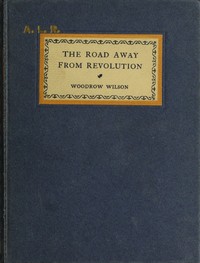
The Road Away from Revolution
first published 1923 · free to read
length
1,039 words
a few pages a day
~8 min
finished in
1 days
full read
4 min
At Folio's default of ten pages a day, you finish The Road Away from Revolution in about 1 days — roughly 8 minutes of reading each morning.
The opening
the first pages of The Road Away from Revolution, free
In these doubtful and anxious days, when all the world is at unrest and, look which way you will, the road ahead seems darkened by shadows which portend dangers of many kinds, it is only common prudence that we should look about us and attempt to assess the causes of distress and the most likely means of removing them.
There must be some real ground for the universal unrest and perturbation. It is not to be found in superficial politics or in mere economic blunders. It probably lies deep at the sources of the spiritual life of our time. It leads to revolution; and perhaps if we take the case of the Russian Revolution, the outstanding event of its kind in our age, we may find a good deal of instruction for our judgment of present critical situations and circumstances.
What gave rise to the Russian Revolution? The answer can only be that it was the product of a whole social system. It was not in fact a sudden thing. It had been gathering head for several generations. It was due to the systematic denial to the great body of Russians of the rights and privileges which all normal men desire and must have if they are to be contented and within reach of happiness. The lives of the great mass of the Russian people contained no opportunities, but were hemmed in by barriers against which they were constantly flinging their spirits, only to fall back bruised and dispirited. Only the powerful were suffered to secure their rights or even to gain access to the means of material success.
It is to be noted as a leading fact of our time that it was against “capitalism” that the Russian leaders directed their attack. It was capitalism that made them see red; and it is against capitalism under one name or another that the discontented classes everywhere draw their indictment.
There are thoughtful and well-informed men all over the world who believe, with much apparently sound reason, that the abstract thing, the system, which we call capitalism, is indispensable to the industrial support and development of modern civilization. And yet everyone who has an intelligent knowledge of social forces must know that great and widespread reactions like that which is now unquestionably manifesting itself against capitalism do not occur without cause or provocation; and before we commit ourselves irreconcilably to an attitude of hostility to this movement of the time, we ought frankly to put to ourselves the question, Is the capitalistic system unimpeachable? which is another way of asking, Have capitalists generally used their power for the benefit of the countries in which their capital is employed and for the benefit of their fellow men?
Is it not, on the contrary, too true that capitalists have often seemed to regard the men whom they used as mere instruments of profit, whose physical and mental powers it was legitimate to exploit with as slight cost to themselves as possible, either of money or of sympathy? Have not many fine men who were actuated by the highest principles in every other relationship of life seemed to hold that generosity and humane feeling were not among the imperative mandates of conscience in the conduct of a banking business, or in the development of an industrial or commercial enterprise?
And if these offenses against high morality and true citizenship have been frequently observable, are we to say that the blame for the present discontent and turbulence is wholly on the side of those who are in revolt against them?
Ought we not, rather, to seek a way to remove such offenses and make life itself clean for those who will share honorably and cleanly in it?
The world has been made safe for democracy. There need now be no fear that any such mad design as that entertained by the insolent and ignorant Hohenzollerns and their counselors may prevail against it. But democracy has not yet made the world safe against irrational revolution. That supreme task, which is nothing less than the salvation of civilization, now faces democracy, insistent, imperative. There is no escaping it, unless everything we have built up is presently to fall in ruin about us; and the United States, as the greatest of democracies, must undertake it.
Keep going from exactly here — Folio remembers your place and serves the next portion tomorrow.
continue reading The Road Away from RevolutionAbout this free edition
The Road Away from Revolution by Woodrow Wilson (1856-1924) is free to read in full. Folio serves it in daily portions you can actually finish, tracks your streak and reading position across devices, and reads every page aloud with a built-in narrator. The text comes from Project Gutenberg.
More like The Road Away from Revolution
When a Man Comes to Himself
Folio
When a Man Comes to Himself
Woodrow Wilson
On Being Human
Woodrow Wilson
The new freedom
Folio
The new freedom
Woodrow Wilson
State of the Union Addresses
Folio
State of the Union Addresses
Woodrow Wilson
Why we are at war
Folio
Why we are at war
Woodrow Wilson

President Wilson's Addresses
Woodrow Wilson
In our first year of war
Folio
In our first year of war
Woodrow Wilson
Congressional government
Woodrow Wilson