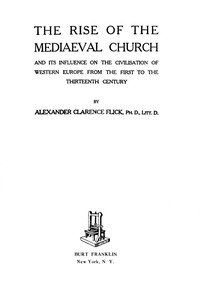
length
174,580 words
a few pages a day
~8 min
finished in
92 days
full read
12h 7m
At Folio's default of ten pages a day, you finish The Rise of the Mediaeval Church in about 92 days — roughly 8 minutes of reading each morning.
The opening
the first pages of The Rise of the Mediaeval Church, free
Who through his numerous scholarly monographs has earned the foremost place among American Church historians, both at home and abroad,
AND TO
PROFESSOR DOCTOR ADOLPH HARNACK
To whom both the Old and the New World are profoundly indebted for his scholarly labours, and from whose inspiration in public lectures and private conferences this work derived much that is best in it,
THIS BOOK IS GRATEFULLY DEDICATED.
PREFACE
The educational value of any subject depends primarily upon its own intrinsic value. The teaching of Church history for ten years as a regular course in liberal arts, side by side with the "orthodox" courses in history, has demonstrated beyond question that this subject can be made at once very popular and very valuable. It has proved its right to exist as a cultural subject. Yet the lack of intelligent information, even among educated people, concerning the history of the Christian Church, both in early and modern days, is simply appalling.
The comparatively recent revival of interest in Church history has given birth to many general Church histories from English and American scholars. Numerous translations of discriminating and painstaking German authors are also available. A large number of intensive monographs has likewise appeared. But all these texts are written for classes in theological schools. Not a single Church history suitable either for regular college work, or for popular reading, is available; and yet all the standard courses in history are provided with up-to-date texts and illustrative material.
This work is intended to meet the need I have felt in my own classes, and have heard expressed from fellow teachers and laymen, for a simple account of the evolution of the old Church minus all theological and dogmatic discussions. The purpose has been to show the origin of the Christian Church, its development in organisation, the forces which produced the Papacy, and the marvellous, formative influence of the Roman Church upon the civilisation of Western Europe. To that end the principal lines of development are emphasised at every point, while the subordinate influences have been minimised. Causes and results, continuity and differentiation, and unity have been constantly kept in mind.
The subject-matter of this volume was worked out during a prolonged residence in Europe. Most of that time was spent in Germany under the inspiration of the foremost authorities in Church history, among whom may be mentioned Professor Nippold of Jena, Professor Loofs of Halle, Professor Hauck of Leipzig, and particularly Professor Harnack of Berlin. The work of the lecture-room and seminar was supplemented by investigation in the Royal Library of Berlin, the Vatican Library at Rome, the National Library at Paris, and the Library of the British Museum. The materials thus gathered were further organised and elaborated in a course of lectures on Church history given in Syracuse University.
The references in the text and the bibliographies at the end of chapters are given, so far as possible, to English sources. It is believed that the exclusion of a pedantic list of foreign works will make the work more useful. It is hoped that the student will be induced to go to the library, the laboratory of the historian, and there by extensive and intensive reading supplement the text.
Should this volume prove to be of service, it will be followed by two companion volumes--one on the Reformation and another on the modern Church. It is further planned to publish a source-book on Church history to supplement the texts.
My indebtedness to books and men is so great that it would be impossible to enumerate them here. While all sources have been laid under tribute, special obligation is felt to many monographs and intensive studies.
ALEXANDER C. FLICK.
SYRACUSE UNIVERSITY.
CONTENTS
PAGE CHAPTER I
THE STUDY OF CHURCH HISTORY 1
OUTLINE: I.--Present status of history in college work. II.--Ecclesiastical history excluded since the Reformation by political history. III.--New view of the Mediæval Church and its influence. IV.--Renaissance of interest in Church history. V.--Pedagogical value and treatment of Church history. VI.--Sources.
Keep going from exactly here — Folio remembers your place and serves the next portion tomorrow.
continue reading The Rise of the Mediaeval ChurchAbout this free edition
The Rise of the Mediaeval Church by Alexander Clarence Flick (1869-1942) is free to read in full. Folio serves it in daily portions you can actually finish, tracks your streak and reading position across devices, and reads every page aloud with a built-in narrator. The text comes from Project Gutenberg.
More like The Rise of the Mediaeval Church
The History of the Peloponnesian War
Folio
The History of the Peloponnesian War
Thucydides
The History of Herodotus
Folio
The History of Herodotus
Herodotus
The Gallic Wars
Folio
The Gallic Wars
Julius Caesar
Anabasis
Folio
Anabasis
Xenophon
The Lives of the Twelve Caesars
Folio
The Lives of the Twelve Caesars
Suetonius
Germania
Folio
Germania
Tacitus
The History of the Decline and Fall of the Roman Empire
Edward Gibbon
The Travels of Marco Polo
Marco Polo