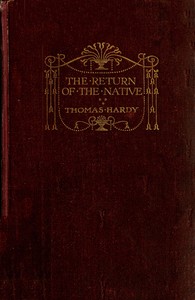
The Return of the Native
first published 1878 · free to read
length
141,608 words
a few pages a day
~8 min
finished in
75 days
full read
9h 50m
At Folio's default of ten pages a day, you finish The Return of the Native in about 75 days — roughly 8 minutes of reading each morning.
The opening
the first pages of The Return of the Native, free
“To sorrow I bade good morrow, And thought to leave her far away behind; But cheerly, cheerly, She loves me dearly; She is so constant to me, and so kind. I would deceive her, And so leave her, But ah! she is so constant and so kind.”
PREFACE
The date at which the following events are assumed to have occurred may be set down as between 1840 and 1850, when the old watering place herein called “Budmouth” still retained sufficient afterglow from its Georgian gaiety and prestige to lend it an absorbing attractiveness to the romantic and imaginative soul of a lonely dweller inland.
Under the general name of “Egdon Heath,” which has been given to the sombre scene of the story, are united or typified heaths of various real names, to the number of at least a dozen; these being virtually one in character and aspect, though their original unity, or partial unity, is now somewhat disguised by intrusive strips and slices brought under the plough with varying degrees of success, or planted to woodland.
It is pleasant to dream that some spot in the extensive tract whose southwestern quarter is here described, may be the heath of that traditionary King of Wessex—Lear.
T.H.
July, 1895.
BOOK FIRST—THE THREE WOMEN
I. A Face on Which Time Makes but Little Impression
A Saturday afternoon in November was approaching the time of twilight, and the vast tract of unenclosed wild known as Egdon Heath embrowned itself moment by moment. Overhead the hollow stretch of whitish cloud shutting out the sky was as a tent which had the whole heath for its floor.
The heaven being spread with this pallid screen and the earth with the darkest vegetation, their meeting-line at the horizon was clearly marked. In such contrast the heath wore the appearance of an instalment of night which had taken up its place before its astronomical hour was come: darkness had to a great extent arrived hereon, while day stood distinct in the sky. Looking upwards, a furze-cutter would have been inclined to continue work; looking down, he would have decided to finish his faggot and go home. The distant rims of the world and of the firmament seemed to be a division in time no less than a division in matter. The face of the heath by its mere complexion added half an hour to evening; it could in like manner retard the dawn, sadden noon, anticipate the frowning of storms scarcely generated, and intensify the opacity of a moonless midnight to a cause of shaking and dread.
In fact, precisely at this transitional point of its nightly roll into darkness the great and particular glory of the Egdon waste began, and nobody could be said to understand the heath who had not been there at such a time. It could best be felt when it could not clearly be seen, its complete effect and explanation lying in this and the succeeding hours before the next dawn; then, and only then, did it tell its true tale. The spot was, indeed, a near relation of night, and when night showed itself an apparent tendency to gravitate together could be perceived in its shades and the scene. The sombre stretch of rounds and hollows seemed to rise and meet the evening gloom in pure sympathy, the heath exhaling darkness as rapidly as the heavens precipitated it. And so the obscurity in the air and the obscurity in the land closed together in a black fraternization towards which each advanced halfway.
The place became full of a watchful intentness now; for when other things sank brooding to sleep the heath appeared slowly to awake and listen. Every night its Titanic form seemed to await something; but it had waited thus, unmoved, during so many centuries, through the crises of so many things, that it could only be imagined to await one last crisis—the final overthrow.
Keep going from exactly here — Folio remembers your place and serves the next portion tomorrow.
continue reading The Return of the NativeAbout this free edition
The Return of the Native by Thomas Hardy (1840-1928) is free to read in full. Folio serves it in daily portions you can actually finish, tracks your streak and reading position across devices, and reads every page aloud with a built-in narrator. The text comes from Project Gutenberg.
More like The Return of the Native
Tess of the d'Urbervilles
Folio
Tess of the d'Urbervilles
Thomas Hardy
Far from the Madding Crowd
Thomas Hardy
Jude the Obscure
Thomas Hardy
The Woodlanders
Folio
The Woodlanders
Thomas Hardy
Under the Greenwood Tree
Folio
Under the Greenwood Tree
Thomas Hardy
Desperate Remedies
Folio
Desperate Remedies
Thomas Hardy
A Pair of Blue Eyes
Folio
A Pair of Blue Eyes
Thomas Hardy
Two on a Tower
Folio
Two on a Tower
Thomas Hardy