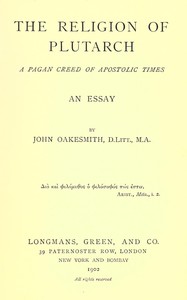
length
68,877 words
a few pages a day
~8 min
finished in
37 days
full read
4h 47m
At Folio's default of ten pages a day, you finish The religion of Plutarch in about 37 days — roughly 8 minutes of reading each morning.
The opening
the first pages of The religion of Plutarch, free
The following pages are practically a reprint of a volume which was issued for private circulation some twelve months ago, under the title “The Religion of Plutarch as expounded in his ‘Ethics.’” The main difference between the present volume and its predecessor consists in the translation or removal of various quotations from Greek and Latin sources which were given in full in the first edition of the book. The references to these sources have, of course, been retained. Verbal corrections have been made here and there, and a few pages of new matter have been introduced into the “Preface.” In other respects the two impressions are substantially the same.
I cannot allow this opportunity to pass without expressing my gratitude to J. E. Sandys, Esq., Litt.D., Public Orator in the University of Cambridge, and Examiner in Greek at the University of London, who kindly placed at my disposal his own copy of the original essay, in which he had made numerous suggestions on points of style, and on questions of scholarship in general. These suggestions have, for the most part, been adopted in the preparation of the present edition. My thanks are also owing to my colleagues in the Civil Service, especially to those in the General Post Office, London, to whose encouragement it is largely due that this essay, in its present form, is able to see the light.
As the Athenæum, in reviewing the original edition (Athenæum, 2nd of August, 1902), suggested that “the present essay is probably the forerunner of a larger and more elaborate book,” it may be desirable to explain that the following pages do not constitute “the larger and more elaborate book” which the Athenæum is right in forecasting.
JOHN OAKESMITH.
PREFACE
When the student of Plutarch leaves the familiar ground of the “Parallel Lives,” and turns, for the first time, to the less thoroughly explored region of the “Ethics,” he is struck with wonder at the many-sided excellence of the writer whose special gift he has been accustomed to regard as consisting in the composition of biographies more remarkable for the presentation of moral truths than for the accurate narration of historical facts. He learns with surprise that Plutarch has bequeathed to posterity a mine of information respecting the period in which he himself lived, as valuable and as interesting as the view presented in his “Lives” of that higher antiquity in which his classic heroes moved and worked. Even the actual bulk of Plutarch’s contribution to what may be called “general literature” is noteworthy. Apart from the “Lives,” the so-called “Catalogue of Lamprias” contains the titles of nearly two hundred works attributed, ostensibly by his son, to Plutarch,[1] and some fourscore of these have been handed down to our time under the general, but somewhat misleading, title of “Ethica” or “Moralia.”
Among these surviving essays are to be found contributions, of a surprising vitality and freshness, to the discussion of Education, Politics, Art, Literature, Music, Hygiene; serious and studied criticisms and appreciations of the great philosophic schools of Greece and their founders; short sermons on minor morals, illustrated by vivid sketches of character both typical and individual; conversations on Love and Marriage, and on other topics perpetually interesting to civilized societies. The longest work of all, the “Symposiacs,” or “Table Talk,” besides containing a wealth of material used by Plutarch and his friends in the discussion of current problems of scientific, literary, and social interest, gives a picture of Græco-Roman Society in the first Christian century, which, both from its general character and from the multitude of details it contains on matters of fact, is of the utmost importance for the accurate study of the period and its complicated problems. All these various works are interpenetrated with the character of the writer to such a vivid degree of personality that their study, from this point of view alone, would probably cast more light upon Plutarch’s methods as a writer of history than innumerable minute and difficult inquiries into his “sources,” and the manner in which he used them in writing his “Lives.”
Keep going from exactly here — Folio remembers your place and serves the next portion tomorrow.
continue reading The religion of PlutarchAbout this free edition
The religion of Plutarch by John Oakesmith is free to read in full. Folio serves it in daily portions you can actually finish, tracks your streak and reading position across devices, and reads every page aloud with a built-in narrator. The text comes from Project Gutenberg.
More like The religion of Plutarch
Meditations
Folio
Meditations
Marcus Aurelius
The Enchiridion
Epictetus
Thus Spake Zarathustra
Friedrich Nietzsche
Beyond Good and Evil
Folio
Beyond Good and Evil
Friedrich Nietzsche
The Genealogy of Morals
Folio
The Genealogy of Morals
Friedrich Nietzsche
The Republic
Folio
The Republic
Plato
Apology
Folio
Apology
Plato
Crito
Folio
Crito
Plato