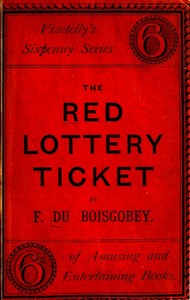
length
50,806 words
a few pages a day
~8 min
finished in
27 days
full read
3h 32m
At Folio's default of ten pages a day, you finish The Red Lottery Ticket in about 27 days — roughly 8 minutes of reading each morning.
The opening
the first pages of The Red Lottery Ticket, free
One day early in April, the month when the lilacs flower and when women begin to display light apparel, a cab could be seen crossing the bridge which spans the Seine between the Faubourg St. Germain and the Louvre, and which is known to the Parisians as the Pont des Saints Pères. The vehicle was going at a quiet trot, and it was driven by a jovial jehu, who hummed a song as he cracked his whip and jerked his reins. Both windows were down, and from each of them came a cloud of bluish smoke--the smoke of the cigars of two young fellows who were gaily chatting inside, and who, although they came from the so-called "Latin Quarter" of Paris, were quite unlike the students immortalised by Gavarni's pencil. They were, indeed, dressed with careful taste, and displayed none of the questionable manners which may be acquired in the drinking dens of the Boulevard St. Michel. One of them, a fair-haired young fellow with soft blue eyes, was named George Caumont, and was the son of a Norman cattle breeder, who lived on his land, saving up his cash, and making his only child an allowance of three thousand francs a year, so that he might complete, in Paris, the study of law which he had commenced at Caen. The other, a dark young man with curly moustaches and a bold expression of face, was the son of a petty nobleman of Périgord, who had left him a heavily mortgaged estate with a somewhat high-sounding name. He was called Adhémar de Puymirol, and lived upon a small allowance made him by an aunt who wished him to become a doctor.
He and George Caumont had met shortly after their arrival in Paris, and their acquaintance had speedily become intimacy, for they had the same ambition and much the same tastes. They both regarded their present situation as a probationary one, hoping sooner or later to contract a brilliant marriage; and they governed themselves accordingly, merely attending the courts and the clinical lectures when they had nothing better to do, and just occasionally passing an examination in order not to discourage Papa Caumont and Aunt Bessèges. But everything comes to an end, and with their relatives grumbling and their creditors barking loudly, there were days when the thought of the future filled them with dismay. Still, on this beautiful spring morning, everything seemed tinged with a roseate hue, and they even laughed at the enforced departure for the provinces apparently so near at hand. "Leave Paris!" said Adhémar, gazing at the scene around him. "Never, George; I would rather give lessons in anatomy to freshmen than go and bury myself in Périgord to doctor my aunt's farmers."
"And I," sighed George, "would rather act as a college tutor than devote the rest of my life to cattle breeding. We are at the end of our tether, unfortunately, and if we don't meet two rich girls before the close of the term, we shall be obliged to decamp, for Paris will be too hot for us."
"Ah, well, we will go to one of the watering-places where heiresses are met."
"You are always so confident!"
"That is the only way to succeed. If our friend Pierre Dargental had become discouraged, we shouldn't now be going to celebrate the close of his bachelor life at lunch. Dargental is no better than we are, and yet he has found a widow of title worth more than a million francs."
"And all he brings her on his side will be his debts--some three hundred thousand francs."
"Oh! in this part of the world, a man shrewd enough to obtain credit to that amount can aspire to anything--"
"Except to the hand of an honest woman," replied George. "There are some pretty hard stories about this Countess de Lescombat's behaviour after her first husband's death."
Keep going from exactly here — Folio remembers your place and serves the next portion tomorrow.
continue reading The Red Lottery TicketAbout this free edition
The Red Lottery Ticket by Fortuné Du Boisgobey (1821-1891) is free to read in full. Folio serves it in daily portions you can actually finish, tracks your streak and reading position across devices, and reads every page aloud with a built-in narrator. The text comes from Project Gutenberg.
More like The Red Lottery Ticket
The Adventures of Sherlock Holmes
Arthur Conan Doyle
The Hound of the Baskervilles
Arthur Conan Doyle
A Study in Scarlet
Folio
A Study in Scarlet
Arthur Conan Doyle
The Sign of the Four
Arthur Conan Doyle
The Memoirs of Sherlock Holmes
Arthur Conan Doyle
The Return of Sherlock Holmes
Arthur Conan Doyle
His Last Bow
Arthur Conan Doyle

The Valley of Fear
Arthur Conan Doyle