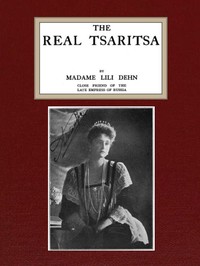
The Real Tsaritsa
first published 1922 · free to read
length
61,841 words
a few pages a day
~8 min
finished in
33 days
full read
4h 18m
At Folio's default of ten pages a day, you finish The Real Tsaritsa in about 33 days — roughly 8 minutes of reading each morning.
The opening
the first pages of The Real Tsaritsa, free
In giving to the world my memories of the Empress Alexandra of Russia, I do not wish to pose as one who is biased by a long and intimate friendship. I write of the Tsaritsa as I knew her: the real Tsaritsa. I was not acquainted with the heroine of the films, the hysterical devotee, or the pro-German who, it is asserted, betrayed both her country by adoption and the country which knew her as a granddaughter of Queen Victoria and the daughter of a much loved English Princess.
Part I--Old Russia
CHAPTER I
I was born on the beautiful estates in South Russia which belonged to my grandmother and my uncle. My father was Ismail Selim Bek Smolsky, whose ancestors hailed from Lithuanian Tartary, and my mother, before her marriage, was Mlle Catherine Horvat, whose grandfather had been invited by the Empress Elizabeth Petrovna to come from Hungary and assist in the colonization of South Russia. Colonel Horvat, who was half Serbian and half Hungarian by birth, was appointed general of the armies of the South by the Empress, and there is a story in our family that when he first arrived in Russia he was taken to the summit of a high mountain and told to look at the panorama of fields and forests lying beneath him.
Colonel Horvat dutifully admired the view, but an unexpected surprise awaited him. “Look well around you, M. le Colonel,” said his guide, “the country, as far as you can see, is yours; it is the gift of the Empress!” Truly an Imperial gift, but all that remains of those great possessions are the estates where I was born. These properties were situated on the Dnieper, in the country known as “Little Russia,” which in former times was the seat of the Ukranian Government. My forefathers became typical Russian noblemen; they were lavishly generous where their inclinations were concerned, and it is asserted that one of them once exchanged a large forest for a sporting dog which he especially coveted!
Revovka, my birthplace, was close to the other estates which came into our possession through Prince Goleniktcheff Koutousoff, the hero who saved Russia from falling into the hands of the French. It was a delightful old house, standing in a well-wooded park, with avenues of lime trees where the nightingales sang, and as I write, I can smell the unforgettable perfume of the limes, and recall the beauty and peace of the surroundings; it was, indeed, a real fairyland. All was prosperity and happiness at Revovka. The village nestled close to the Great House, and my ancestors were buried in the church. There were rows of little cottages which were whitewashed every week; the roofs were thatched with reeds, and the gardens were gay with flowers. A cherry tree stood in every garden (cherry trees are typical of South Russia), it was the country of cherry trees, spotless houses and simple joys.
The peasants were on the best of terms with my family, and they regarded my grandmother Horvat as a beneficent deity who replaced the reed roofs when they were destroyed by fire, and who supplied them with unlimited quantities of fuel. They were quite contented, and my grandmother still employed some of the peasants who had once been given to her as serfs. In the old days, it was customary to include a few serfs in a bride’s corbeille, and the ten peasants who had been chosen to accompany my grandmother to Revovka adored her. “People say that we were unhappy as serfs,” they would often remark, “but we were always well looked after--our landlord and our owner was also our father.”
The peasant as master or mistress was invariably a tyrant, and I remember hearing about a beautiful girl who had become the mistress of a great nobleman, and who out-Heroded Herod in her arrogance. She employed her family to do her laundry work, and she always insisted upon her linen being rinsed in running water. If her petticoats were not sufficiently starched, the whole batch of her relatives was flogged. Personally, we did not resent the lack of starch, to this extent, but I suppose that this family flogging may be regarded as typical of the usual procedure of beggars on horseback!
Keep going from exactly here — Folio remembers your place and serves the next portion tomorrow.
continue reading The Real TsaritsaAbout this free edition
The Real Tsaritsa by Lili Den (1888-1963) is free to read in full. Folio serves it in daily portions you can actually finish, tracks your streak and reading position across devices, and reads every page aloud with a built-in narrator. The text comes from Project Gutenberg.
More like The Real Tsaritsa
The History of the Peloponnesian War
Folio
The History of the Peloponnesian War
Thucydides
The History of Herodotus
Folio
The History of Herodotus
Herodotus
The Gallic Wars
Folio
The Gallic Wars
Julius Caesar
Anabasis
Folio
Anabasis
Xenophon
The Lives of the Twelve Caesars
Folio
The Lives of the Twelve Caesars
Suetonius
Germania
Folio
Germania
Tacitus

The History of the Decline and Fall of the Roman Empire
Edward Gibbon
The Travels of Marco Polo
Marco Polo