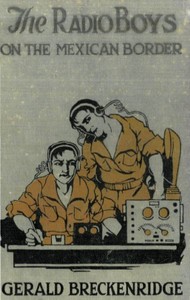
length
49,625 words
a few pages a day
~8 min
finished in
27 days
full read
3h 27m
At Folio's default of ten pages a day, you finish The Radio Boys on the Mexican Border in about 27 days — roughly 8 minutes of reading each morning.
The opening
the first pages of The Radio Boys on the Mexican Border, free
The development of radio telephony is still in its infancy at this time of writing in 1922. And yet it has made strides that were undreamed of in 1918. Experiments made in that year in Germany, and by the Italian Government in the Adriatic, enabled the human voice to be projected by radio some hundreds of miles. Today the broadcasting stations, from which nightly concerts are sent far and wide across the land, have tremendous range.
Estimates compiled by the various American companies making and selling radiophone equipment showed that in March of 1922 there were more than 700,000 receiving sets installed throughout the country and that installations were increasing so rapidly it was impossible to compute the percentage with any degree of accuracy, as the gains even from week to week were great.
When you boys read this the problems of control of the air will have been simplified to some extent. Yet at the beginning of 1922 they were simply chaotic. Then the United States Government of necessity took a hand. The result will be, eventually, that certain wave lengths will be set aside for the exclusive use of amateurs, others for commercial purposes, still others for governmental use, and so on.
In this connection, you will note that in the story Jack Hampton's father builds sending stations on Long Island and in New Mexico. This is unusual and requires explanation.
The tremendous growth of amateur receiving stations is due in part to the fact that such stations require no governmental license. A sending station, on the other hand, does require a license, and such license is not granted except upon good reasons being shown. It would be natural for the government, however, to give Mr. Hampton license to use a special wave length--such as 1,800 metres--for transoceanic radio experiments. Extension of the license to the New Mexico plant would follow.
THE AUTHOR.
DIRECTIONS FOR INSTALLING AN AMATEUR RADIO RECEIVING TELEPHONE
In order that the boy interested in radio telephony may construct his own receiving set, the Author herein will describe the construction of a small, cheap set which almost any lad handy at mechanics can build. Such a set should be sufficiently powerful to permit of successfully picking up the concerts and other programme entertainments being broadcasted frequently by stations throughout the country.
Two drawings are given herewith which will enable boys to visualize the appearance of the set, and will be of aid in following instructions.
Referring to Figure 1 let us examine first the construction of the receiving inductance marked L. The latter is shown in detail in Figure 2, and consists of a heavy piece of cardboard. The back of an ordinary writing pad will do.
[Illustration: Figure 1]
First, draw the circle out with a compass to the diameter shown and then divide off the outside into an unequal number of divisions as shown. Draw a light pencil line through each of these marks to the centre of the circle. Now with your scissors cut out the disc, after which you cut the slots as shown.
The slots should be about one-quarter of an inch in width and of the depth shown in the drawing. Two such discs should be made and, when all cut out, should be given several coats of shellac to add stiffness and to improve the insulating qualities.
Now at your hardware dealer's buy one-quarter pound of No. 24 double, cotton-covered wire and proceed to wind the coils in the manner shown. Keep the windings even and avoid all joints throughout the length of winding.
Keep going from exactly here — Folio remembers your place and serves the next portion tomorrow.
continue reading The Radio Boys on the Mexican BorderAbout this free edition
The Radio Boys on the Mexican Border by Gerald Breckenridge (1889?-1964) is free to read in full. Folio serves it in daily portions you can actually finish, tracks your streak and reading position across devices, and reads every page aloud with a built-in narrator. The text comes from Project Gutenberg.
More like The Radio Boys on the Mexican Border
Treasure Island
Robert Louis Stevenson
Kidnapped
Robert Louis Stevenson

The Call of the Wild
Jack London

White Fang
Jack London

The Sea-Wolf
Jack London

The Count of Monte Cristo
Alexandre Dumas
The Three Musketeers
Folio
The Three Musketeers
Alexandre Dumas
Robinson Crusoe
Folio
Robinson Crusoe
Daniel Defoe