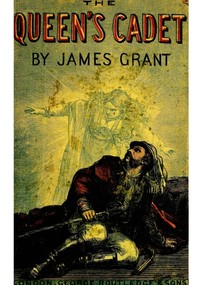
The Queen's cadet, and other tales
free to read
length
62,171 words
a few pages a day
~8 min
finished in
33 days
full read
4h 19m
At Folio's default of ten pages a day, you finish The Queen's cadet, and other tales in about 33 days — roughly 8 minutes of reading each morning.
The opening
the first pages of The Queen's cadet, and other tales, free
"I have been forced to believe in the existence and influence of an unseen world, of something which is described in that line of Dryden's,
"'With silent steps I follow you all day.'
"I have felt the influence of the spiritual and invisible on the senses, though I know nothing of the complications, the deceptions and alleged perils, forming a portion of that which is now termed spiritualism; and which affirms that the unseen world cannot become manifest, save in obedience to certain occult laws which regulate the phenomena of nature."
What rigmarole was this?
Could the speaker--this man with the melancholy tone and saddened eye--actually be the same handsome Jack Arkley, my old college chum at Sandhurst, who was always rather sceptical even in religious matters, who was one of the merriest fellows there, who had been once nearly rusticated for breaking the lamps and dismounting the guns to spite the adjutant, but who, as a Queen's cadet, had more marks of excellence than any of us; who was afterwards the beau-ideal of a fine young English officer--a prime bat and bowler, who pulled a good stroke oar, had such a firm seat in his saddle, and who was the best hand for organizing a picnic, a ball, or a scratch company, for amateur theatricals; and who in the late expedition against the Looshais, had won the reputation of being a regular fire-eater--a fellow who would face the devil in his shirt sleeves!
Could the champagne of "the Rag" have affected him, thought I, as he continued earnestly and sadly, and while manipulating a cigar selected from the silver stand on the table:
"I have somewhere read that very few persons in this world have been unfortunate enough to have seen those things that are invisible to others."
"By Jove! Do you mean a--ghost?"
"Not exactly the vulgar ghost of the nursery," said he, his pale face colouring slightly.
"But we have all met with those who knew some one else who had seen something weird, unearthly, unexplainable."
"Precisely; but I shall speak from personal experience--so now for a little narrative of my own."
We had dined that evening at the club, where D---- of the Greys had given a few fellows a dinner, in honour of being gazetted to his troop, and to "wet" the new commission; and though it seemed to me that, like the rest of us, Jack Arkley had done justice to all the good things set before him, from the soup to the coffee and curaçao, he had been, during dinner, remarkably triste or abstracted, and took but little interest in the subjects discussed by the guests, who were mostly all upon short leave from Aldershot, and, the Spring drills being over, were thankful to exchange the white dust of the Long Valley, for the Row or Regent Street.
We were alone now, and lingering over some iced brandy-pawnee (as we called it in India) in the cool bay-window of his room in Piccadilly, where it overlooked the pleasant Green Park and where the clock of Westminster was shining above the trees, like a red harvest moon. So I prepared to listen to him with more curiosity than belief, while he related the following singular story, which he would never have ventured to relate to the circle of heedless fellows whom we had just left.
"My parents died when I was little more than an infant, leaving me to the care of two uncles, a maternal one, named Beverley, a man of considerable wealth, who in consequence of a quarrel with my father, whose marriage with his sister he resented, totally ignored my existence, and was ever a kind of myth to me; the other a paternal one, a bachelor curate in North Wales, poor old Morgan Apreece Arkley, than whom there was no better or more kind-hearted man in all the principality.
"His means were most limited; but to share the little he possessed he made me freely and tenderly welcome, all the more so that to two appeals he had made to the generosity of my Uncle Beverley, no response was ever returned--a cutting coldness and rudeness, bitterly resented by my hot-tempered but warm-hearted old Welsh kinsman.
Keep going from exactly here — Folio remembers your place and serves the next portion tomorrow.
continue reading The Queen's cadet, and other talesAbout this free edition
The Queen's cadet, and other tales by James Grant (1822-1887) is free to read in full. Folio serves it in daily portions you can actually finish, tracks your streak and reading position across devices, and reads every page aloud with a built-in narrator. The text comes from Project Gutenberg.
More like The Queen's cadet, and other tales
A Haunted Life
James Grant
The dead tryst
James Grant
The Mysteries of All Nations
Folio
The Mysteries of All Nations
James Grant
Pride and Prejudice
Jane Austen
Sense and Sensibility
Jane Austen
Emma
Folio
Emma
Jane Austen
Persuasion
Folio
Persuasion
Jane Austen
Mansfield Park
Folio
Mansfield Park
Jane Austen