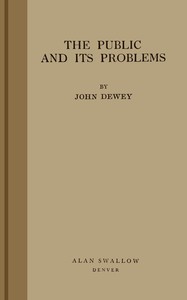
The public and its problems
free to read
length
55,033 words
a few pages a day
~8 min
finished in
29 days
full read
3h 49m
At Folio's default of ten pages a day, you finish The public and its problems in about 29 days — roughly 8 minutes of reading each morning.
The opening
the first pages of The public and its problems, free
This volume is the result of lectures delivered during the month of January, nineteen hundred and twenty-six, upon the Larwill Foundation of Kenyon College, Ohio. In acknowledging the many courtesies received, I wish to express also my appreciation of the toleration shown by the authorities of the College to delay in publication. The intervening period has permitted a full revision and expansion of the lectures as originally delivered. This fact will account for an occasional reference to books published in the interval.
J. D.
CONTENTS
CHAPTER PAGE I. SEARCH FOR THE PUBLIC 3
Divergence of facts and theoretical interpretations concerning the nature of the state, 3. Practical import of theories, 5. Theories in terms of causal origin, 9. Theory in terms of perceived consequences, 12. Distinction of private and public substituted for that of individual and social, 13. The influence of association, 22. Plurality of associations, 26. Criterion of the public, 27. Function of the state, 28. The state as an experimental problem, 32. Summary, 34.
II. DISCOVERY OF THE STATE 37
Public and state, 38. Geographical extent, 39. Multiplicity of states, 43. Spread of consequences, 47. Law is not command, 53. Law and reasonableness, 55. The public and long-established habits of action, 57. Fear of the new, 59. Irreparable consequences, 62. Variation of state-functions according to circumstances of time and place, 65. State and government, 66. State and society, 69. The pluralistic theory, 73.
III. THE DEMOCRATIC STATE 75
Private and representative rôles of officials, 76. Selection of rulers by irrelevant methods, 78. The problem of control of officials, 82. Meanings of democracy, 83. Fallacy as to origin of democratic government, 84. Influence of non-political factors, 85. The origin of “individualism,” 86. Influence of the new industry; the theory of “natural” economic laws, 90. James Mill’s philosophy of democratic government, 93. Criticism of “individualism,” 95. Criticism of antithesis of natural and artificial, 102. Wants and aims as functions of social life, 104. Persistence of pre-industrial institutions, 108. Final problem, 109.
IV. ECLIPSE OF THE PUBLIC 110
Local origin of American democratic government, 111. National unification due to technological factors, 114. Submergence of the public, 116. Disparity of inherited ideas and machinery with actual conditions, 117. Illustrations of resulting failures, 119. Problem of discovering the public, 122. Democracy versus the expert, 123. Explanation of eclipse of public, 126. Illustrated by the World War, 127. Application of criteria of the public, 129. Failure of traditional principles, 131. Political apathy accounted for, 134. Need of experts, 135. Rivals of political interest, 138. Ideals and instrumentalities, 141.
V. SEARCH FOR THE GREAT COMMUNITY 143
Democracy as idea and as governmental behavior, 143. Problem of the Great Community, 147. Meaning of the democratic ideal, 148. Democracy and community life, 149. Community and associated activity, 151. Communication and the community, 152. Intellectual conditions of the Great Community, 155. Habit and intelligence, 158. Science and knowledge, 163. Limitations upon social inquiry, 166. Isolation of social inquiry, 171. Pure and applied science, 172. Communication and public opinion, 173. Limitations of distribution of knowledge, 176. Communication as art, 183.
Keep going from exactly here — Folio remembers your place and serves the next portion tomorrow.
continue reading The public and its problemsAbout this free edition
The public and its problems by John Dewey (1859-1952) is free to read in full. Folio serves it in daily portions you can actually finish, tracks your streak and reading position across devices, and reads every page aloud with a built-in narrator. The text comes from Project Gutenberg.
More like The public and its problems
How We Think
Folio
How We Think
John Dewey
Reconstruction in Philosophy
John Dewey
Democracy and Education
Folio
Democracy and Education
John Dewey
German Philosophy and Politics
Folio
German Philosophy and Politics
John Dewey

Ethics
John Dewey
Moral Principles in Education
Folio
Moral Principles in Education
John Dewey
China, Japan and the U.S.A.
Folio
China, Japan and the U.S.A.
John Dewey
The Child and the Curriculum
Folio
The Child and the Curriculum
John Dewey