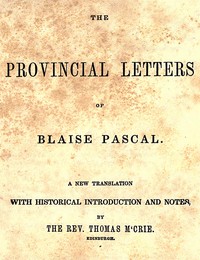
The Provincial Letters
first published 1657 · free to read
length
147,556 words
a few pages a day
~8 min
finished in
78 days
full read
10h 15m
At Folio's default of ten pages a day, you finish The Provincial Letters in about 78 days — roughly 8 minutes of reading each morning.
The opening
the first pages of The Provincial Letters, free
Design of the Jesuits in establishing a new system of morals—Two sorts of casuists among them—A great many lax and some severe ones—Reason of this difference—Explanation of the doctrine of probabilism—A multitude of modern and unknown authors substituted in the place of the holy fathers—Escobar, 116
LETTER VI.
Various artifices of the Jesuits to elude the authority of the gospel, of councils, and of the popes—Some consequences resulting from their doctrine of probability—Their relaxations in favor of beneficiaries, of priests, of monks, and of domestics—Story of John d’Alba, 135
LETTER VII.
Method of directing the intention adopted by the casuists—Permission to kill in defence of honor and property, extended even to priests and monks—Curious question raised as to whether Jesuits may be allowed to kill Jansenists, 152
LETTER VIII.
Corrupt maxims of the casuists relating to judges—Usurers—The Contract Mohatra—Bankrupts—Restitution—Divers ridiculous notions of these same casuists, 170
LETTER IX.
False worship of the Virgin introduced by the Jesuits—Devotion made easy—Their maxims on ambition, envy, gluttony, equivocation, mental reservations, female dress, gaming, and hearing mass, 188
LETTER X.
Palliatives applied by the Jesuits to the sacrament of penance, in their maxims regarding confession, satisfaction, absolution, proximate occasions of sin, and love to God, 206
LETTER XI.
The Letters vindicated from the charge of profaneness—Ridicule a fair weapon, when employed against absurd opinions—Rules to be observed in the use of this weapon—Charitableness and discretion of the Provincial Letters—Specimens of genuine profaneness in the writings of Jesuits, 225
LETTER XII.
The quirks and chicaneries of the Jesuits on the subjects of alms-giving and simony, 243
LETTER XIII.
Fidelity of Pascal’s quotations—Speculative murder—Killing for slander—Fear of the consequences—The policy of Jesuitism, 260
LETTER XIV.
On murder—The Scriptures on murder—Lessius, Molina, and Layman on murder—Christian and Jesuitical legislation contrasted, 277
LETTER XV.
On calumny—M. Puys and Father Alby—An odd heresy—Barefaced denials—Flat contradictions and vague insinuations employed by the Jesuits—The Capuchin’s Mentiris impudentissime, 295
LETTER XVI.
Calumnies against Port-Royal—Port-Royalists no heretics—M. de St. Cyran and M. Arnauld vindicated—Slanders against the nuns of Port-Royal—Miracle of the holy thorn—No impunity for slanderers—Excuse for a long letter, 314
LETTER XVII.
The author of the Letters vindicated from the charge of heresy—The five propositions—The popes fallible in matters of fact—Persecution of the Jansenists—The grand object of the Jesuits, 341
LETTER XVIII.
The sense of Jansenius not the sense of Calvin—Resistibility of grace—Jansenius no heretic—The popes may be surprised—Testimony of the senses—Condemnation of Galileo—Conclusion, 366
LETTER XIX.
Fragment of a nineteenth Provincial Letter, addressed to Père Annat, 391
THE TRANSLATOR’S PREFACE.
The following translation of the Provincial Letters was undertaken several years ago, in compliance with the suggestion of a revered parent, chiefly as a literary recreation in a retired country charge, and, after being finished, was laid aside. It is now published at the request of friends, who considered such a work as peculiarly seasonable, and more likely to be acceptable at the present crisis, when general attention has been again directed to the popish controversy, and when such strenuous exertions are being made by the Jesuits to regain influence in our country.
Keep going from exactly here — Folio remembers your place and serves the next portion tomorrow.
continue reading The Provincial LettersAbout this free edition
The Provincial Letters by Blaise Pascal (1623-1662) is free to read in full. Folio serves it in daily portions you can actually finish, tracks your streak and reading position across devices, and reads every page aloud with a built-in narrator. The text comes from Project Gutenberg.
More like The Provincial Letters
Pensées
Folio
Pensées
Blaise Pascal
The Thoughts of Blaise Pascal
Folio
The Thoughts of Blaise Pascal
Blaise Pascal
The History of the Peloponnesian War
Folio
The History of the Peloponnesian War
Thucydides
The History of Herodotus
Folio
The History of Herodotus
Herodotus
The Gallic Wars
Folio
The Gallic Wars
Julius Caesar
Anabasis
Folio
Anabasis
Xenophon
The Lives of the Twelve Caesars
Folio
The Lives of the Twelve Caesars
Suetonius
Germania
Folio
Germania
Tacitus