length
58,824 words
a few pages a day
~8 min
finished in
31 days
full read
4h 5m
At Folio's default of ten pages a day, you finish The Prodigal Pro Tem in about 31 days — roughly 8 minutes of reading each morning.
The opening
the first pages of The Prodigal Pro Tem, free
If Barnes had been asked to define the one thing lacking in the scene before him, he would probably have answered sentimentally, “A woman--a young and very fair woman,” not that he had any definite figure in mind, but simply because from an artist’s view point the picture, wonderful as it was, seemed now like a marvelous setting without its jewel.
A light breeze from the West, heavy with summer incense, wafted through a golden-moted silence and across a turquoise sky with cotton-blossom clouds. Dense, yet of gossamer fineness; massive, yet light as thistledown, they took their course placidly without disturbing the perfect serenity of their background. In their constant changing, they appeared at times like Spanish galleons with every full-bellied sail straining at its ropes. But they cut no churning path; they left no oily wake. They only cast calm shadows which in their turn swept majestically over the green valley below them. The heavy-leaved trees, the fat grasses, the daisies and roadside ferns found themselves first in the stark sunlight, then in the quiet shade, then in the brazen sun again.
If Barnes had not been in tune with it all, he would have felt out of place here on the top of the long hill up which he had just climbed by the saffron road. As it was, he surveyed the scene with an air of easy content. To a passer-by he might have given the impression of being a large proprietor. In his heavy walking-boots, his belted trousers, his flannel shirt gathered in at the throat with a light tie, his checked English cap, and his walking-stick, he looked as though he might be making a walking tour of his landed estates. He had a comfortable air of princely sovereignty. His even features, his tall erect frame, his gray-blue eyes, and above all his thin, straight nose carried out the illusion. He had an air more of Bavaria than New England. But his firm lips, surmounted by a bristling blonde mustache, trimmed short and in a straight line, together with his Saxon hair, marked him of a hardier race. He might have been a Dane, but his cheek bones were too high for that, and there was too much good humor written large about the mouth. As a matter of fact he was from New York state and his ancestors had fought under Schuyler. His great grandfather was quoted as having said, “I’d rather be killed as a private under Schuyler than live, a captain, under Gates.” A sentiment his father had paraphrased when he raged at the walking delegate who tried to unionize his shops, “I’ll go broke by myself before I’ll get rich under you.” From that day Barnes, Sr., had moved from one apartment house to another in New York city in a steady crescendo of advancing rentals until now he needed a secretary to look after the tipping alone. And “The Acme Manufacturing Co.” was wrought in iron scrolls across the oven doors of half the cook-stoves in the United States.
This fact, however, had less to do with Barnes to-day than the more romantic one that his father in the days of beginnings, married his book-keeper, a fine-souled English girl, niece of the late Lord Dunnington. Her father, a younger son, came to America to make his fortune, died soon after, and left the girl penniless. To-day the one romantic spot left in Barnes, Sr., was his ambition to accumulate a fortune so vast that it might overawe his caddish English relatives. It was the mother in Barnes, Jr., and not the father who now stood upon the top of the hills dreaming into the cotton-blossom clouds.
His pose was misleading. Barnes was proprietor of nothing but himself. That was much or little as you happened to feel about it. To himself it was enough to make him glad that he stood here to-day even with only a trifle over ten round dollars to his name. The position was of his own choosing. He might have been secretary to the Acme Manufacturing Co. had he wished, instead of a painter of very good water-colors which as yet, however, had not found so ready a market as the cook-stoves.
Keep going from exactly here — Folio remembers your place and serves the next portion tomorrow.
continue reading The Prodigal Pro TemAbout this free edition
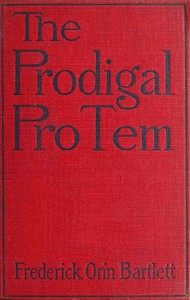
The Prodigal Pro Tem by Frederick Orin Bartlett (1876-1945) is free to read in full. Folio serves it in daily portions you can actually finish, tracks your streak and reading position across devices, and reads every page aloud with a built-in narrator. The text comes from Project Gutenberg.
More like The Prodigal Pro Tem
The Triflers
Folio
The Triflers
Frederick Orin Bartlett
Pride and Prejudice
Jane Austen
Sense and Sensibility
Jane Austen
Emma
Folio
Emma
Jane Austen
Persuasion
Folio
Persuasion
Jane Austen
Mansfield Park
Folio
Mansfield Park
Jane Austen
Jane Eyre
Charlotte Brontë
The Tenant of Wildfell Hall
Folio
The Tenant of Wildfell Hall
Anne Brontë