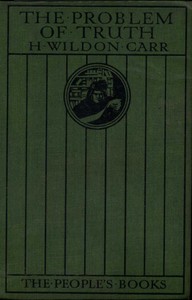
length
28,350 words
a few pages a day
~8 min
finished in
15 days
full read
1h 58m
At Folio's default of ten pages a day, you finish The Problem of Truth in about 15 days — roughly 8 minutes of reading each morning.
The opening
the first pages of The Problem of Truth, free
A problem of philosophy is completely different from a problem of science. In science we accept our subject-matter as it is presented in unanalysed experience; in philosophy we examine the first principles and ultimate questions that concern conscious experience itself. The problem of truth is a problem of philosophy. It is not a problem of merely historical interest, but a present problem--a living controversy, the issue of which is undecided. Its present interest may be said to centre round the doctrine of pragmatism, which some fifteen years ago began to challenge the generally accepted principles of philosophy. In expounding this problem of truth, my main purpose has been to make clear to the reader the nature of a problem of philosophy and to disclose the secret of its interest. My book presumes no previous study of philosophy nor special knowledge of its problems. The theories that I have shown in conflict on this question are, each of them, held by some of the leaders of philosophy. In presenting them, therefore, I have tried to let the full dialectical force of the argument appear. I have indicated my own view, that the direction in which the solution lies is in the new conception of life and the theory of knowledge given to us in the philosophy of Bergson. If I am right, the solution is not, like pragmatism, a doctrine of the nature of truth, but a theory of knowledge in which {vi} the dilemma in regard to truth does not arise. But, as always in philosophy, the solution of one problem is the emergence of another. There is no finality.
My grateful acknowledgment is due to my friend Professor S. Alexander, who kindly read my manuscript and assisted me with most valuable suggestions, and also to my friend Dr. T. Percy Nunn for a similar service.
H. WILDON CARR.
{vii}
CONTENTS
CHAP.
I. PHYSICS AND METAPHYSICS II. APPEARANCE AND REALITY III. THE LOGICAL THEORIES IV. THE ABSOLUTE V. PRAGMATISM VI. UTILITY VII. ILLUSION VIII. THE PROBLEM OF ERROR IX. CONCLUSION BIBLIOGRAPHY INDEX
{9}
THE PROBLEM OF TRUTH
CHAPTER I
PHYSICS AND METAPHYSICS
The progress of physical science leads to the continual discovery of complexity in what is first apprehended as simple. The atom of hydrogen, so long accepted as the ideal limit of simplicity, is now suspected to be not the lowest unit in the scale of elements, and it is no longer conceived, as it used to be, as structureless, but as an individual system, comparable to a solar system, of electrical components preserving an equilibrium probably only temporary. The same tendency to discover complexity in what is first apprehended as simple is evident in the study of philosophy. The more our simple and ordinary notions are submitted to analysis, the more are profound problems brought to consciousness. It is impossible to think that we do not know what such an ordinary, simple notion as that of truth is; yet the attempt to give a definition of its meaning brings quite unexpected difficulties to light, and the widest divergence at the present time between rival principles of philosophical interpretation is in regard to a theory of the nature of truth. It is not a problem that is pressed on us by any felt need, nor is anyone who does not feel its interest called upon to occupy himself with it. We speak our language before we know its {10} grammar, and we reason just as well whether we have learnt the science of logic or not.
Keep going from exactly here — Folio remembers your place and serves the next portion tomorrow.
continue reading The Problem of TruthAbout this free edition
The Problem of Truth by Herbert Wildon Carr (1857-1931) is free to read in full. Folio serves it in daily portions you can actually finish, tracks your streak and reading position across devices, and reads every page aloud with a built-in narrator. The text comes from Project Gutenberg.
More like The Problem of Truth
Meditations
Folio
Meditations
Marcus Aurelius
The Enchiridion
Epictetus

Thus Spake Zarathustra
Friedrich Nietzsche
Beyond Good and Evil
Folio
Beyond Good and Evil
Friedrich Nietzsche
The Genealogy of Morals
Folio
The Genealogy of Morals
Friedrich Nietzsche
The Republic
Folio
The Republic
Plato
Apology
Folio
Apology
Plato
Crito
Folio
Crito
Plato