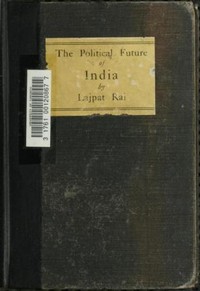
length
75,285 words
a few pages a day
~8 min
finished in
40 days
full read
5h 14m
At Folio's default of ten pages a day, you finish The Political Future of India in about 40 days — roughly 8 minutes of reading each morning.
The opening
the first pages of The Political Future of India, free
My book, Young India, was written during the first year of the war and was finally revised and sent to the press before the war was two years old. It concluded with the following observation:
"The Indians are a chivalrous people; they will not disturb England as long as she is engaged with Germany. The struggle after the war might, however, be even more bitter and sustained."
The events that have happened since have amply justified the above conclusion. India not only refrained from disturbing England while she was engaged in war with Germany, but actively helped in defeating Germany and winning the war. She raised an army of over a million combatants and supplied a large number of war workers, and made huge contributions in money and materials. She denied herself the necessities of life in order to feed and equip the armies in the field though within the last months of the war, when scarcity and epidemic overtook her, she lost six millions of her sons and daughters from one disease alone--influenza. This was more than chivalry. This was self-effacement in the interests of an Empire which, in the past, had treated her children as helots. How much of this effort was voluntary and how much of it was forced it is difficult to appraise. Great Britain, however, has unequivocally accepted it as voluntary and has attributed it to India's satisfaction with her rule. That India was not satisfied with her rule she has spared no pains to impress upon the British people as well as the rest of the world. Reading between the lines of the report of the Secretary of State for India and the Viceroy has established the fact of that dissatisfaction beyond the possibility of doubt, but if any doubt still remained it has been dispelled by the writings and utterances of her representative spokesman in India, in Great Britain and abroad. The prince and the peasant, the landlord and the ryot, the professor and the student, the politician and the layman--all have spoken. They differ in their estimates of the "blessings" of British rule, they differ in the manner of their profession of loyalty to the British Empire, they sometimes differ in shaping their schemes for the future Government of India but they are all agreed:
(1) That the present constitution of the Government of India is viciously autocratic, bureaucratic, antiquated and unsatisfying.
(2) That India has, in the past, been governed more in the interests of, and by the British merchant and the British aristocrat than in the interests of her own peoples.
(3) That the neglect of India's education and industries has been culpably tragic and
(4) That the only real and effectual remedy is to introduce an element of responsibility in the Government of India.
Keep going from exactly here — Folio remembers your place and serves the next portion tomorrow.
continue reading The Political Future of IndiaAbout this free edition
The Political Future of India by Lala Lajpat Rai (1865-1928) is free to read in full. Folio serves it in daily portions you can actually finish, tracks your streak and reading position across devices, and reads every page aloud with a built-in narrator. The text comes from Project Gutenberg.
More like The Political Future of India
The History of the Peloponnesian War
Folio
The History of the Peloponnesian War
Thucydides
The History of Herodotus
Folio
The History of Herodotus
Herodotus
The Gallic Wars
Folio
The Gallic Wars
Julius Caesar
Anabasis
Folio
Anabasis
Xenophon
The Lives of the Twelve Caesars
Folio
The Lives of the Twelve Caesars
Suetonius
Germania
Folio
Germania
Tacitus

The History of the Decline and Fall of the Roman Empire
Edward Gibbon
The Travels of Marco Polo
Marco Polo