length
161,607 words
a few pages a day
~8 min
finished in
86 days
full read
11h 13m
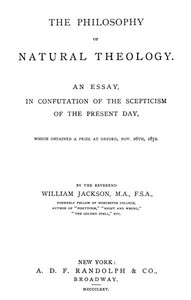
At Folio's default of ten pages a day, you finish The Philosophy of Natural Theology in about 86 days — roughly 8 minutes of reading each morning.
The opening
the first pages of The Philosophy of Natural Theology, free
Circumstances have induced an Individual, who wishes to remain unknown, to offer a Prize of £100, to be competed for by Members of the University of Oxford of not less standing than Master of Arts, and by any above that standing, for the best Essay in confutation of the Materialism of the present day by arguments derived from Evidences of Intelligence, Design, Contrivance, and Adaptation of Means to Ends, in the Universe, and especially in Man considered in his Moral Nature, his Religious Aptitudes, and his Intellectual Powers; and in all Organic Nature. The observation also to be made and supported in the course of the Essay that the Will and Wisdom of the Creator may be a sufficient cause for deviations from the established course of nature, and that the Free-will of man, in things within his power and influence, may be a cause of similar deviations.
It is desired that all arguments used against Materialism should be independent of those of Hegel, and of what is called the Spiritual Philosophy, which had its rise in Germany.
A period of two years will be allowed after the Public Announcement of the subject before the competing Essays will be required to be sent in to the Judges: and it is a condition of the competition that the Copyright of the successful Essay shall be the property of the Donor of the Prize; but that if published, the profits (if any) shall belong to the Writer.
The Very Reverend the Dean of St. Paul's, the Regius Professor of Divinity, and the Rev. C. Pritchard, Savilian Professor of Astronomy, have consented to act as Judges.
Essays must be sent to the Registrar of the University on or before the 12th of June, 1872. The Essays are to be distinguished by mottoes, the writer's name being sent at the same time in a sealed envelope, in the manner prescribed for the Chancellor's Prizes.
F. K. LEIGHTON, Vice-Chancellor.
ALL SOULS COLLEGE, June 13, 1870.
After the decease of Dean Mansel the last clause but one of the above notice was thus modified in the Gazette for Dec. 5th, 1871:--
The Very Reverend the Dean of Canterbury, the Regius Professor of Divinity, and the Rev. C. Pritchard, Savilian Professor of Astronomy, have consented to act as Judges.
The following announcement appeared in the Gazette for Nov. 26th, 1872:--
PRIZE ESSAY.
The Judges appointed to award a Prize of £100 offered for the best Essay in confutation of Materialism have adjudged the Prize to the Rev. W. JACKSON, M.A., F.S.A., late Fellow of Worcester College.
H. G. LIDDELL, Vice-Chancellor.
November 25, 1872.
In a letter dated Dec. 26th, 1872, the Donor of the Prize surrendered any claim that he might have upon the Copyright of the Essay, and requested the Author to proceed with its publication.
PREFACE.
The Essay now published is the expansion of a thin volume by the present writer, which was printed more than four years ago.[1] Natural Theology, considered as a science, had been at that time pronounced extinct and impossible by very eminent authorities. From this decision I felt myself constrained to differ; and thought it worth while to put on record a plea for what appeared to me an unduly neglected branch of Philosophy.
Such contempt of a pursuit possessing so many claims on the favourable attention of educated minds, seemed a fact to be accounted for in some way. After considerable thought, I ventured on asserting that the method latterly employed in treatises on this once popular science, furnished the true reason of its decline and fall. That method I could not avoid condemning as both inadequate and suicidal.
Keep going from exactly here — Folio remembers your place and serves the next portion tomorrow.
continue reading The Philosophy of Natural TheologyAbout this free edition
The Philosophy of Natural Theology by William Jackson (1817?-1891?) is free to read in full. Folio serves it in daily portions you can actually finish, tracks your streak and reading position across devices, and reads every page aloud with a built-in narrator. The text comes from Project Gutenberg.
More like The Philosophy of Natural Theology
Meditations
Folio
Meditations
Marcus Aurelius
The Enchiridion
Epictetus
Thus Spake Zarathustra
Friedrich Nietzsche
Beyond Good and Evil
Folio
Beyond Good and Evil
Friedrich Nietzsche
The Genealogy of Morals
Folio
The Genealogy of Morals
Friedrich Nietzsche
The Republic
Folio
The Republic
Plato
Apology
Folio
Apology
Plato
Crito
Folio
Crito
Plato