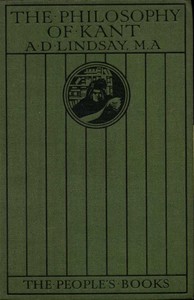
The Philosophy of Immanuel Kant
free to read
length
23,319 words
a few pages a day
~8 min
finished in
13 days
full read
1h 37m
At Folio's default of ten pages a day, you finish The Philosophy of Immanuel Kant in about 13 days — roughly 8 minutes of reading each morning.
The opening
the first pages of The Philosophy of Immanuel Kant, free
"It is a difficult matter," says Heine, "to write the life history of Immanuel Kant, for he had neither life nor history. He lived a mechanically ordered, abstract, old bachelor kind of existence in a quiet, retired alley in Koenigsberg, an old town in the north-east corner of Germany." The times he lived in were stirring enough. He was born in 1724, and died in 1804. He lived through the Seven Years' War that first made Germany a nation, he followed with sympathy the United States War of Independence, he saw the French Revolution and the beginning of the career of Napoleon. Yet in all his long life he never moved out of the province in which he was born, and nothing was allowed to interrupt the steady course of his lecturing, studying, and writing. "Getting up," continues Heine, "drinking coffee, lecturing, eating, going for a walk, everything had its fixed time; and the neighbours knew that it must be exactly half-past four when Immanuel Kant, in his gray frock-coat, with his Spanish cane in his hand, stepped from his door and walked towards the little lime-tree avenue, which is called after him the Philosopher's Walk." "Strange contrast," reflects Heine, "between the man's outward life and his destructive, world-smashing thoughts." As the political history of the eighteenth century came to an end when the French Revolution spilled over the borders of France and drove Napoleon up and down Europe, breaking up the old political systems and inaugurating modern Europe, so its opposing currents of thought were gathered together in the mind of a weak-chested, half-invalid little man in Koenigsberg, and from their meeting a new era in philosophy began.
There are some philosophers to whom truth seems to come almost unsought, as an immediate authoritative vision. Kant was not one of these. His greatest work, the Critique of Pure Reason, was conceived when he was forty-eight, and published in 1781, when he was fifty-seven. It was the outcome of half a lifetime's patient study and thought. Heine says of him: "He was the perfect type of the small shopkeeper. Nature had meant him to weigh coffee and sugar, but fate willed that he should weigh other things and put a God on his scales, and his weighing was exact." The sneer is unjust, but there is something in the simile; for Kant's philosophy was a kind of taking stock, a survey of the great movement of thought from the time when the Renaissance and the Reformation made thought free, an attempt to estimate the achievements of the new sciences, to deal with their conflicting claims and ideals and say what it all came to. In Kant modern science, which began with Descartes and Galileo, first became conscious of itself.
This taking stock Kant called Criticism. His great books are all called Critiques--the Critique of Pure Reason, the Critique of Practical Reason, the Critique of Judgment. He called his philosophy the Critical Philosophy or Critical Idealism. Essential to an understanding of Kant is an understanding of what he meant by criticism, and why he opposes it to dogmatism and scepticism; for the necessity and possibility of such a criticism was his great philosophical discovery. We have called Kant's work a survey of the achievements of the thought of his times, but it was very much more than that, and has a much more universal significance than could belong to any history of the thought of one epoch. For these achievements of thought, though great, were conflicting and partial. They contrasted with failure and barrenness in other directions, and they seemed to be due to different methods. This success of thought in one direction and its failure in another, and this uncertainty about the true method of science, were problems which at once presented themselves to an impartial observer, and Kant held that they could be answered only by taking stock of actual attainments, and by criticism of the powers and range of human thought in general.
Keep going from exactly here — Folio remembers your place and serves the next portion tomorrow.
continue reading The Philosophy of Immanuel KantAbout this free edition
The Philosophy of Immanuel Kant by A. D. Lindsay (1879-1952) is free to read in full. Folio serves it in daily portions you can actually finish, tracks your streak and reading position across devices, and reads every page aloud with a built-in narrator. The text comes from Project Gutenberg.
More like The Philosophy of Immanuel Kant
Meditations
Folio
Meditations
Marcus Aurelius
The Enchiridion
Epictetus
Thus Spake Zarathustra
Friedrich Nietzsche
Beyond Good and Evil
Folio
Beyond Good and Evil
Friedrich Nietzsche
The Genealogy of Morals
Folio
The Genealogy of Morals
Friedrich Nietzsche
The Republic
Folio
The Republic
Plato
Apology
Folio
Apology
Plato
Crito
Folio
Crito
Plato