length
116,512 words
a few pages a day
~8 min
finished in
62 days
full read
8h 5m
At Folio's default of ten pages a day, you finish The philosophy of biology in about 62 days — roughly 8 minutes of reading each morning.
The opening
the first pages of The philosophy of biology, free
The text of this e-book has mostly been preserved in its original form, but a number of typographic errors have been corrected silently – they are listed at the end of the book. Missing or inconsistent punctuation has been corrected silently in a few places, but inconsistent hyphenation has not been altered. An index item that lacked a page reference has been remedied, and an archaic symbol representing the mathematical ‘factorial’ function has been replaced by the standard exclamation mark (!). Footnotes have been numbered and positioned below the relevant paragraphs. The marker for footnote 31 was missing from the original text and has been arbitrarily placed at the end of the relevant paragraph.
In this plain text version, italic text is denoted by underscores. Superscripted characters are surrounded by curly brackets preceded by a caret symbol, e.g. 2^{10}, and subscripted characters are surrounded by curly brackets preceded by a downward arrow, e.g. ↓{H}.
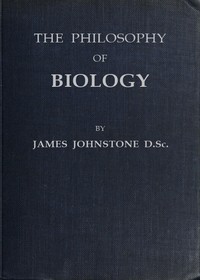
THE PHILOSOPHY OF BIOLOGY
CAMBRIDGE UNIVERSITY PRESS London: FETTER LANE, E.C. C. F. CLAY, Manager
[Illustration]
Edinburgh: 100 PRINCES STREET Berlin: A. ASHER AND CO. Leipzig: F. A. BROCKHAUS New York: G. P. PUTNAM’S SONS Bombay and Calcutta: MACMILLAN AND CO., LTD. Toronto: J. M. DENT & SONS, LTD. Tokyo: THE MARUZEN-KABUSHIKI-KAISHA
All rights reserved
THE PHILOSOPHY
OF
BIOLOGY
BY
JAMES JOHNSTONE, D.Sc.
Cambridge: at the University Press 1914
INTRODUCTION
It has been suggested that some reference, of an apologetic nature, to the title of this book may be desirable, so I wish to point out that it can really be justified. Science, says Driesch, is the attempt to describe Givenness, and Philosophy is the attempt to understand it. It is our task, as investigators of nature, to describe what seems to us to happen there, and the knowledge that we so attain--that is, our perceptions, thinned out, so to speak, modified by our mental organisation, related to each other, classified and remembered--constitutes our Givenness. This is only a description of what seems to us to be nature. But few of us remain content with it, and the impulse to go beyond our mere descriptions is at times an irresistible one. Fettered by our habits of thought, and by the limitations of sensation, we seem to look out into the dark and to see only the shadows of things. Then we attempt to turn round in order that we might discover what it is that casts the shadows, and what it is in ourselves that gives shape to them. We seek for the Reality that we feel is behind the shadows. That is Philosophy.
The Physics of a generation earlier than our own thought that it had discovered Reality in its conception of an Universe consisting of atoms and molecules in ceaseless motion. What it described were only motions and transformations, but it understood these motions and transformations as matter and energy. Yet more subtle minds than the great physicists of the beginning of the nineteenth century had already seen that sensation might mislead us. There was something in us that continually changed--that was our consciousness, and it was all that we knew. If external things did exist they existed only because we thought them. But we ourselves exist, for we are not only a stream of consciousness that continually changes, but there is in us a personality, or identity, which has remained the same throughout all the vicissitudes of our consciousness. If the things that exist for us exist only because we think them, and if we also exist, then we must exist in the thought of an Absolute Mind that thinks us. Physical Science, studying only motions and transformations, understood that there was something that moved and transformed--this was matter and energy. Mental Science, studying only thought, understood that nature was only the thought of an Universal Mind. Either conclusion was equally valid Philosophy (or metaphysics), and neither could be proved or disproved by the methods of Science. The speculative game is drawn, said Huxley, let us get to practical work!
Keep going from exactly here — Folio remembers your place and serves the next portion tomorrow.
continue reading The philosophy of biologyAbout this free edition
The philosophy of biology by James Johnstone (1870-1932) is free to read in full. Folio serves it in daily portions you can actually finish, tracks your streak and reading position across devices, and reads every page aloud with a built-in narrator. The text comes from Project Gutenberg.
More like The philosophy of biology
Meditations
Folio
Meditations
Marcus Aurelius
The Enchiridion
Epictetus
Thus Spake Zarathustra
Friedrich Nietzsche
Beyond Good and Evil
Folio
Beyond Good and Evil
Friedrich Nietzsche
The Genealogy of Morals
Folio
The Genealogy of Morals
Friedrich Nietzsche
The Republic
Folio
The Republic
Plato
Apology
Folio
Apology
Plato
Crito
Folio
Crito
Plato