length
25,007 words
a few pages a day
~8 min
finished in
14 days
full read
1h 44m
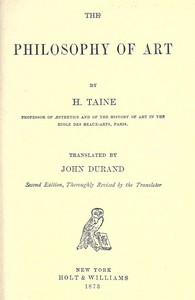
At Folio's default of ten pages a day, you finish The Philosophy of Art in about 14 days — roughly 8 minutes of reading each morning.
The opening
the first pages of The Philosophy of Art, free
The now famous name of Taine was first introduced to the American public by the issue, in 1865, of a small imported edition of this work. That edition has long been out of print here and in Europe. That the book is now re-issued may be subject of special satisfaction to those who already possess the Author's "Ideal in Art" "Art in the Netherlands" and "Art in Greece" as this work (now published in a style uniform with others named) is properly the forerunner of them all; containing, as it does, the principles laid down in the Author's first course of lectures, and constantly referred to in the later courses which now form the books before alluded to.
In preparing this edition for the press, the translator, by bringing to bear the experience gained in the later works, has made it a great improvement on the previous edition.
PREFACE TO THE FIRST EDITION.
The translation herewith presented to the reader consists of a course of Lectures delivered during the winter of 1864, before the Students of Art of the École des Beaux Arts at Paris, by H. Taine, Professeur d'Esthétique et d' Histoire de l'Art in that institution.
These lectures, as a system of Æsthetics, consist of an application of the experimental method to art, in the same manner as it is applied to the sciences. Whatever utility the system possesses is due to this principle. The author undertakes to explain art by social influences and other causes; humanity at different times and places, climate, and other conditions, furnish the facts on which the theory rests. The artistic development of any age or people is made intelligible through a series of historical inductions terminating in a few inferential laws, constituting what the title of the book declares it to be--the philosophy of art.
Such a system seems to possess many advantages. Among others, it tends to emancipate the student of art, as well as the amateur, from metaphysical and visionary theories growing out of false theories and traditional misconceptions; he is not misled by an exclusive adherence to particular schools, masters, or epochs. It also tends to render criticism less capricious, and therefore less injurious; dictating no conventional standard of judgment, it promotes a spirit of charity towards all works. As there is no attempt to do more than explain art according to natural laws, the reader must judge whether, like all systems assuming to bring order out of confusion, this one fulfils its mission.
Readers familiar with M. Taine's able and original work on English literature (Histoire de la Littérature Anglaise) will recognize in the following pages the same theory applied to art as is therein applied to literature.
J. D.
LONDON, November 9, 1865.
PREFACE TO THE SECOND EDITION.
Since the publication of the first edition of the "Philosophy of Art" seven years ago, in London, its author has become deservedly popular, and especially in this country. His writings are sought for, read and translated both in England and on the continent of Europe, and it would be but refining gold to say aught in his praise. Like every man of genius he has, as time moves on, improved in his order of thought and in his wonderfully artistic style. His latest work, "On Intelligence" ranks him as high among thinkers, as his former works among men of letters.
The present edition is a careful revision of the former one, and amounts, indeed, to a new translation. Were either to be compared with the original, no change of sense could probably be detected. The present edition, however, being much more literal, the translator considers it an improvement, and hopes that it will be found more worthy of its gifted author, the publishers, his indulgent critics, and the public generally.
Keep going from exactly here — Folio remembers your place and serves the next portion tomorrow.
continue reading The Philosophy of ArtAbout this free edition
The Philosophy of Art by Hippolyte Taine (1828-1893) is free to read in full. Folio serves it in daily portions you can actually finish, tracks your streak and reading position across devices, and reads every page aloud with a built-in narrator. The text comes from Project Gutenberg.
More like The Philosophy of Art
The Ancient Regime
Folio
The Ancient Regime
Hippolyte Taine
Meditations
Folio
Meditations
Marcus Aurelius
The Enchiridion
Epictetus
Thus Spake Zarathustra
Friedrich Nietzsche
Beyond Good and Evil
Folio
Beyond Good and Evil
Friedrich Nietzsche
The Genealogy of Morals
Folio
The Genealogy of Morals
Friedrich Nietzsche
The Republic
Folio
The Republic
Plato
Apology
Folio
Apology
Plato