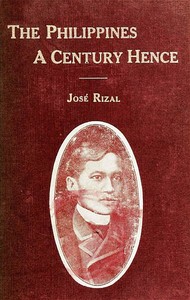
The Philippines a Century Hence
free to read
length
15,769 words
a few pages a day
~8 min
finished in
9 days
full read
1h 6m
At Folio's default of ten pages a day, you finish The Philippines a Century Hence in about 9 days — roughly 8 minutes of reading each morning.
The opening
the first pages of The Philippines a Century Hence, free
"In the Philippine Islands the American government has tried, and is trying, to carry out exactly what the greatest genius and most revered patriot ever known in the Philippines, Jose Rizal, steadfastly advocated."
--From a public address at Fargo, N.D., on April 7th. 1903, by the President of the United States.
INTRODUCTION
As "Filipinas dentro de Cien Anos", this article was originally published serially in the Filipino fortnightly review "La Solidaridad", of Madrid, running through the issues from September, 1889, to January, 1890.
It supplements Rizal's great novel "Noli Me Tangere" and its sequel "El Filibusterismo", and the translation here given is fortunately by Mr. Charles Derbyshire who in his "The Social Cancer" and "The Reign of Greed" has so happily rendered into English those masterpieces of Rizal.
The reference which Doctor Rizal makes to President Harrison had in mind the grandson-of-his-grandfather's blundering, wavering policy that, because of a groundless fear of infringing the natives' natural rights, put his country in the false light of wanting to share in Samoa's exploitation, taking the leonine portion, too, along with Germany and England.
Robert Louis Stevenson has told the story of the unhappy condition created by that disastrous international agreement which was achieved by the dissembling diplomats of greedy Europe flattering unsophisticated America into believing that two monarchies preponderating in an alliance with a republic would be fairer than the republic acting unhampered.
In its day the scheme was acclaimed by irrational idealists as a triumph of American abnegation and an example of modern altruism. It resulted that "the international agreement" became a constant cause of international disagreements, as any student of history could have foretold, until, disgusted and disillusioned, the United States tardily recalled Washington's warning against entanglements with foreign powers and became a party to a real partition, but this time playing the lamb's part. England was compensated with concessions in other parts of the world, the United States was "given" what it already held under a cession twenty-seven years old,--and Germany took the rest as her emperor had planned from the start.
There is this Philippine bearing to the incident that the same stripe of unpractical philanthropists, not discouraged at having forced the Samoans under the ungentle German rule--for their victims and not themselves suffer by their mistakes, are seeking now the neutralization by international agreement of the Archipelago for which Rizal gave his life. Their success would mean another "entangling alliance" for the United States, with six allies, or nine including Holland, China and Spain, if the "great republic" should be allowed by the diplomats of the "Great Powers" to invite these nonentities in world politics, with whom she would still be outvoted.
Rizal's reference to America as a possible factor in the Philippines' future is based upon the prediction of the German traveller Feodor Jagor, who about 1860 spent a number of months in the Islands and later published his observations, supplemented by ten years of further study in European libraries and museums, as "Travels in the Philippines", to use the title of the English translation,--a very poor one, by the way. Rizal read the much better Spanish version while a student in the Ateneo de Manila, from a copy supplied by Paciano Rizal Mercado who directed his younger brother's political education and transferred to Jose the hopes which had been blighted for himself by the execution of his beloved teacher, Father Burgos, in the Cavite alleged insurrection.
Keep going from exactly here — Folio remembers your place and serves the next portion tomorrow.
continue reading The Philippines a Century HenceAbout this free edition
The Philippines a Century Hence by José Rizal (1861-1896) is free to read in full. Folio serves it in daily portions you can actually finish, tracks your streak and reading position across devices, and reads every page aloud with a built-in narrator. The text comes from Project Gutenberg.
More like The Philippines a Century Hence
The Indolence of the Filipino
Folio
The Indolence of the Filipino
José Rizal
The History of the Peloponnesian War
Folio
The History of the Peloponnesian War
Thucydides
The History of Herodotus
Folio
The History of Herodotus
Herodotus
The Gallic Wars
Folio
The Gallic Wars
Julius Caesar
Anabasis
Folio
Anabasis
Xenophon
The Lives of the Twelve Caesars
Folio
The Lives of the Twelve Caesars
Suetonius
Germania
Folio
Germania
Tacitus
The History of the Decline and Fall of the Roman Empire
Edward Gibbon