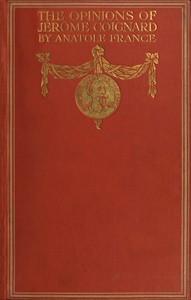
The Opinions of Jerome Coignard
free to read
length
44,251 words
a few pages a day
~8 min
finished in
24 days
full read
3h 4m
At Folio's default of ten pages a day, you finish The Opinions of Jerome Coignard in about 24 days — roughly 8 minutes of reading each morning.
The opening
the first pages of The Opinions of Jerome Coignard, free
There is no need for me to tell over again here the life of Monsieur l’Abbé Jérôme Coignard, professor of oratory at the college of Beauvais, librarian to Monseigneur de Séez, Sagiensis episcopi bibliothecarius solertissimus, as his epitaph has it, later on secretary at the Cemetery of the Holy Innocents, and finally curator of that queen of libraries (the Astaracian), whose loss is for ever to be deplored. He perished, assassinated, on the Lyons road, by a Jew cabalist of the name of Mosaïde (Judæa manu nefandissima), leaving several incomplete works, and the memory of his admirable familiar conversation. All the circumstances of his odd existence and tragic end have been reported by his disciple Jacques Menétrier, called Tournebroche, or Turnspit, because he was the son of a cook in the Rue St. Jacques. This Tournebroche professed for him whom it was his habit to speak of as his good master, a lively and tender admiration. “His was the kindliest soul,” said he, “that ever blossomed on this earth.” Modestly and faithfully he edited the memoirs of the Abbé, who lives again in the work as Socrates does in the Memorabilia of Xenophon.
Observant, exact, and charitable, he drew a portrait full of life and instinct with a loving faithfulness. It is a work that makes one think of those portraits of Erasmus by Holbein that one sees in the Louvre, at Bale, or at Hampton Court, the delicacy of which never wearies the sense of appreciation. In short, he left us a masterpiece. It will cause surprise no doubt, that he was not careful to have it printed. Moreover, he could have published it himself, for he set up as a bookseller in the Rue St. Jacques at the sign of the Image de Sainte Catherine, where he succeeded Blaizot.
Perhaps, living as he did among books, he feared to add, if it were but a few leaves, to the horrible hoard of blackened paper that mildews unseen on the book-stalls. We may share his disgust when we pass the twopenny box on the quays, where the sun and the rain slowly consume pages written for immortality. Like those pathetic death’s-heads that Bossuet sent to the Abbot of la Trappe to divert his solitude, here are subjects for reflection fitted to make the man of letters conceive the vanity of writing. I may say, for my part, that between the Pont Royal and the Pont Neuf, I have felt that vanity to the full. I should incline to believe that Abbé Coignard’s pupil never printed his work because, formed by so good a master, he judged sanely of literary glory, and esteemed it at its worth, and that is exactly nothing. He knew it for uncertain, capricious, subject to every vicissitude, and dependent on circumstances themselves petty and wretched. Seeing his contemporaries, ignorant, abusive, and mediocre, he saw no reason to hope that their posterity would suddenly become learned, balanced, and reliable. He merely divined that the Future, a stranger to our quarrels, would accord indifference in default of justice. We are well-nigh assured that, great and small, the Future will unite us in oblivion and cover us in a peaceful uniformity of silence. But if, by some extraordinary chance, that hope deceives us, if future generations keep some memory of our name and writings, we can foresee that they will only make acquaintance with our thoughts by the ingenious labour of gloss and super-gloss which alone perpetuates works of genius through the ages. The long life of a masterpiece is assured only at the price of quite pitiable intellectual hazards, in which the gabble of pedants reinforces the ingenious word-twisting of æsthetic souls. I am not afraid to say that, at the present day, we do not understand a single line of the Iliad, of the Divine Comedy, in the sense primitively attaching to it. To live is to change, and the posthumous life of our written-down thoughts is not free from the rule: they only continue to exist on condition that they become more and more different from what they were when they issued from our minds. Whatsoever in future may be admired in us, will have become altogether alien from us.
Keep going from exactly here — Folio remembers your place and serves the next portion tomorrow.
continue reading The Opinions of Jerome CoignardAbout this free edition
The Opinions of Jerome Coignard by Anatole France (1844-1924) is free to read in full. Folio serves it in daily portions you can actually finish, tracks your streak and reading position across devices, and reads every page aloud with a built-in narrator. The text comes from Project Gutenberg.
More like The Opinions of Jerome Coignard
Honey-Bee
Anatole France
Bee: The Princess of the Dwarfs
Anatole France
The Red Lily
Folio
The Red Lily
Anatole France
The Life of Joan of Arc
Folio
The Life of Joan of Arc
Anatole France
Meditations
Folio
Meditations
Marcus Aurelius
The Enchiridion
Epictetus
Thus Spake Zarathustra
Friedrich Nietzsche
Beyond Good and Evil
Folio
Beyond Good and Evil
Friedrich Nietzsche