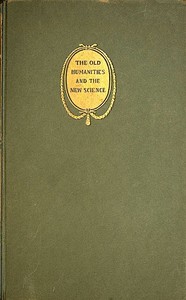
The Old Humanities and the New Science
free to read
length
12,064 words
a few pages a day
~8 min
finished in
7 days
full read
50 min
At Folio's default of ten pages a day, you finish The Old Humanities and the New Science in about 7 days — roughly 8 minutes of reading each morning.
The opening
the first pages of The Old Humanities and the New Science, free
IN writing a prefatory note to an American reprint of this notable address there are three things to consider--the writer, his subject, and the occasion. The greatly beloved author had a multitude of friends in all lands, and far abler pens have written much concerning him during the past twelve months. The subject is one of no less moment on this side of the Atlantic than to those in older countries who concern themselves with scholarship and education, though here the classicists are having a particularly hard struggle to retain in our academies, schools, and colleges a proper footing for the ancient languages and learning termed "the humanities." The circumstances under which the address was given are less familiar in this country than the author and his subject, for we as yet have no corresponding organization, or at least none with such an ambitious programme. Consequently it is appropriate that this note should dwell chiefly upon the occasion.
The Classical Association, composed of a large body of university men, teachers, and schoolmasters, with local branches in several places in Great Britain and her colonies, was established in 1904 with this object:
To promote the development and maintain the well-being of classical studies and in particular:
(a) To impress upon public opinion the claim of such studies to an eminent place in the national scheme of education;
(b) To improve the practice of classical teaching by free discussion of its scope and methods;
(c) To encourage investigation and call attention to new discoveries;
(d) To create opportunities for friendly intercourse and co-operation among all lovers of classical learning in this country.
That Sir William Osler should have been chosen to preside over such an assembly of British scholars is no matter for surprise, for though a humanist in the broad sense of the term as a student of human affairs and human nature, rather than of Latin and Greek, he at the same time was a wide reader with a "relish for knowledge," successful not only in its quest in many fields beyond that of his chosen profession, but particularly so in his ability to hand his literary gleanings on to others in a new and attractive form. Nevertheless, the presidency of the Classical Association, considering the avowed objects of this body, was a most signal honour in view of his reputation primarily as a scientist and teacher of medicine.
His immediate predecessor, the Professor of Greek at Christ Church, opened his presidential address of the year before with these words:
It is the general custom of this Association to choose as its President alternately a classical scholar and a man of wide eminence outside the classics. Next year you are to have a man of science, a great physician who is also famous in the world of learning and literature. Last year you had a statesman, who, though a statesman, is also a great scholar and man of letters, a sage and counsellor in the antique mould, of world-wide fame and unique influence.
Thus, though in himself sufficiently representative of humanistic culture, Osler was in this strict sense an alternate, and among the fourteen earlier Presidents of the Association three had like himself been Fellows of the Royal Society, which long since had abandoned even the pretence of concerning itself with classical studies which had been the very basis of the Revival of Learning.
The list of Presidents since the foundation of the Association may be a matter of interest to those in this country who may not have been aware of the existence and purposes of this organization of British scholars:
Keep going from exactly here — Folio remembers your place and serves the next portion tomorrow.
continue reading The Old Humanities and the New ScienceAbout this free edition
The Old Humanities and the New Science by William Osler (1849-1919) is free to read in full. Folio serves it in daily portions you can actually finish, tracks your streak and reading position across devices, and reads every page aloud with a built-in narrator. The text comes from Project Gutenberg.
More like The Old Humanities and the New Science
The Evolution of Modern Medicine
Folio
The Evolution of Modern Medicine
William Osler
Meditations
Folio
Meditations
Marcus Aurelius
The Enchiridion
Epictetus
Thus Spake Zarathustra
Friedrich Nietzsche
Beyond Good and Evil
Folio
Beyond Good and Evil
Friedrich Nietzsche
The Genealogy of Morals
Folio
The Genealogy of Morals
Friedrich Nietzsche
The Republic
Folio
The Republic
Plato
Apology
Folio
Apology
Plato