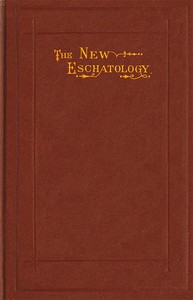
length
25,767 words
a few pages a day
~8 min
finished in
14 days
full read
1h 47m
At Folio's default of ten pages a day, you finish The New Eschatology in about 14 days — roughly 8 minutes of reading each morning.
The opening
the first pages of The New Eschatology, free
This little work was published in England several years ago; but has never before been republished in this country. It deals with those texts of Scripture which have generally been supposed to foretell the destruction of the material universe; and shows conclusively that these passages have been entirely misunderstood by commentators; and that, rightly interpreted, they have no reference whatever to the outer realm of matter, but to the inner realm of mind; to the internal condition of the church, the loss or destruction of heavenly charity, and the eclipse of genuine faith, which it was foreseen and foretold would occur at the close of the first Christian Dispensation.
It is proper to add, also, that, although the name of Swedenborg nowhere occurs in the book, it is evident that the author was familiar with his teachings, and viewed and treated his subject from the Swedenborgian stand-point. But with the lovers of spiritual truth and the seekers after a Spiritual Christianity, this fact--now that so many earnest inquirers are beginning to read the writings of the Swedish seer--will rather add to than detract from the interest and value of the work.
AMERICAN EDITOR. PHILADELPHIA, Oct. 30, 1871.
THE NEW ESCHATOLOGY.
For the first heaven and the first earth were passed away; and there was no more sea.--REV. xxi. 1.
While we blame the conduct of the Jews in adhering only to the literal sense of the Scriptures, and by such adherence rejecting their Messiah, we possibly forget that the Christian church has followed precisely the same line of conduct; and that to this we are indebted for the greater part of those absurd dogmas, which have so long exposed the Gospel to the derision of its enemies. Had men properly discriminated between those parts of the Sacred Volume which are literally true, and those which are only apparently so, we should never have heard of the doctrines of transubstantiation and Roman supremacy; nor of many other equally absurd beliefs which the generality of Christians entertain. We should not have seen a fallible and weak mortal exalted as Head over the church of God; we should not have heard of a morsel of bread being changed into the Lord's body; we should not have seen the Divine Nature divided among three separate and distinct Persons; nor should we have heard of the doctrine which we are about to bring under consideration.
But do not mistake me. When I assert that the Scriptures in the literal sense sometimes speak only apparent truth, I by no means deny the divine authority of the Sacred Record. The church whose doctrines I advocate, most explicitly declares that the whole of the Scriptures,--every chapter,--every verse,--every word, nay, sometimes every letter--is filled with the inbreathed wisdom of God. But when I say that apparent and not real truths are often laid down in the letter of the Word, I affirm what every man who possesses any share of discernment will readily admit. The fact itself is too plain even to require proof. Thus we read that the sun rises, moves, and sets; which is certainly true in appearance, but not in reality. Again we are told that the LORD repents,--that He is weary, and that He turns away His face from man; which, though correct as regards appearance, has no foundation in literal fact; for though the Sun of Righteousness is said to rise upon the soul, and to set when the mind is given up to evil, yet it is here as in the case of the material sun. In God "there is no variableness nor shadow of turning;"--"He fainteth not, neither is weary;"--"He is not a man that He should lie, nor the son of man that He should repent;" but as the earth, by turning to or from the sun, causes the appearance of motion in that body; so the mind of man, by turning to the Lord, or by departing from Him, causes an appearance of change in God; yet it is not He that changes, but the mind itself.
Keep going from exactly here — Folio remembers your place and serves the next portion tomorrow.
continue reading The New EschatologyAbout this free edition
The New Eschatology by J. G. Broughton Pegg is free to read in full. Folio serves it in daily portions you can actually finish, tracks your streak and reading position across devices, and reads every page aloud with a built-in narrator. The text comes from Project Gutenberg.
More like The New Eschatology
Meditations
Folio
Meditations
Marcus Aurelius
The Enchiridion
Epictetus
Thus Spake Zarathustra
Friedrich Nietzsche
Beyond Good and Evil
Folio
Beyond Good and Evil
Friedrich Nietzsche
The Genealogy of Morals
Folio
The Genealogy of Morals
Friedrich Nietzsche
The Republic
Folio
The Republic
Plato
Apology
Folio
Apology
Plato
Crito
Folio
Crito
Plato