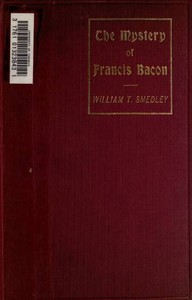
The Mystery of Francis Bacon
free to read
length
57,503 words
a few pages a day
~8 min
finished in
31 days
full read
4h
At Folio's default of ten pages a day, you finish The Mystery of Francis Bacon in about 31 days — roughly 8 minutes of reading each morning.
The opening
the first pages of The Mystery of Francis Bacon, free
"Si bene qui latuit, bene vixit, tu bene vivis: Ingeniumque tuum grande latendo patet." --John Owen's Epigrammatum, 1612.
LONDON: ROBERT BANKS & SON, RACQUET COURT, FLEET STREET E.C.
1912.
"_But such is the infelicity and unhappy disposition of the human mind in the course of invention that it first distrusts and then despises itself: first will not believe that any such thing can be found out; and when it is found out, cannot understand how the world should have missed it so long._"
--"NOVUM ORGANUM," Chap. CX.
CONTENTS.
PAGE Preface 5 CHAPTER I.--Sources of Information 9 II.--The Stock from which Bacon Came 14 III.--Francis Bacon, 1560 to 1572 19 IV.--At Cambridge 25 V.--Early Compositions 29 VI.--Bacon's "Temporis Partus Maximus" 36 VII.--Bacon's First Allegorical Romance 47 VIII.--Bacon in France, 1576-1579 52 IX.--Bacon's Suit on His Return to England, 1580 62 X.--The "Rare and Unaccustomed Suit" 76 XI.--Bacon's Second Visit to the Continent and After 82 XII.--Is it Probable that Bacon left Manuscripts Hidden Away? 94 XIII.--How the Elizabethan Literature was Produced 98 XIV.--The Clue to the Mystery of Bacon's Life 103 XV.--Burghley and Bacon 114 XVI.--The 1623 Folio Edition of Shakespeare's Plays 123 XVII.--The Authorised Version of the Bible, 1611 126 XVIII.--How Bacon Marked Books with the Publication of Which He Was Connected 132 XIX.--Bacon and Emblemata 140 XX.--Shakespeare's Sonnets 148 XXI.--Bacon's Library 156 XXII.--Two German Opinions on Shakespeare and Bacon 161 XXIII.--The Testimony of Bacon's Contemporaries 170 XXIV.--The Missing Fourth Part of "The Great Instauration" 177 XXV.--The Philosophy of Bacon 187 Appendix 193
PREFACE.
Is there a mystery connected with the life of Francis Bacon? The average student of history or literature will unhesitatingly reply in the negative, perhaps qualifying his answer by adding:--Unless it be a mystery that a man with such magnificent intellectual attainments could have fallen so low as to prove a faithless friend to a generous benefactor in the hour of his trial, and, upon being raised to one of the highest positions of honour and influence in the State, to become a corrupt public servant and a receiver of bribes to pervert justice.--It is one of the most remarkable circumstances to be found in the history of any country that a man admittedly pre-eminent in his intellectual powers, spoken of by his contemporaries in the highest terms for his virtues and his goodness, should, in subsequent ages, be held up to obloquy and scorn and seldom be referred to except as an example of a corrupt judge, a standing warning to those who must take heed how they stand lest they fall. Truly the treatment which Francis Bacon has received confirms the truth of the aphorism, "The evil that men do lives after them; the good is oft interred with their bones."
It is not the intention in the following brief survey of Bacon's life to enter upon any attempt to vindicate his character. Since his works and life have come prominently before the reading public, he has never been without a defender. Montagu, Hepworth Dixon, and Spedding have, one after the other, raised their voices against the injustice which has been done to the memory of this great Englishman; and although Macaulay, in his misleading and inaccurate essay,[1] abounding in paradoxes and inconsistencies, produced the most powerful, though prejudiced, attack which has been made on Bacon's fame, he may almost be forgiven, because it provided the occasion for James Spedding in "Evenings with a Reviewer," to respond with a thorough and complete vindication of the man to whose memory he devoted his life. There rests on every member of the Anglo-Saxon race an obligation--imposed upon him by the benefits which he enjoys as the result of Francis Bacon's life-work--to read this vindication of his character. Nor should mention be omitted of the essay by Mr. J. M. Robertson on "Francis Bacon" in his excellent work "Pioneer Humanists." All these defenders of Bacon treat their subject from what may be termed the orthodox point of view. They follow in the beaten track. They do not look for Bacon outside his acknowledged works and letters. Since 1857, however, there has been steadily growing a belief that Bacon was associated with the literature of the Elizabethan and early Jacobean periods, and that he deliberately concealed his connection with it. That this view is scouted by what are termed the men of letters is well-known. They will have none of it. They refuse its claim to a rational hearing. But, in spite of this, as years go on, the number of adherents to the new theory steadily increases. The scornful epithets that are hurled at them only appear to whet their appetite, and increase their determination. Men and women devote their lives with enthusiasm to the quest for further knowledge. They dig and delve in the records of the period, and in the byeways of literature. Theories which appear extravagant and untenable are propounded. Whether any of these theories will come to be accepted and established beyond cavil, time alone can prove. But, at any rate, it is certain that in this quest many forgotten facts are brought to light, and the general stock of information as to the literature of the period is augmented.
Keep going from exactly here — Folio remembers your place and serves the next portion tomorrow.
continue reading The Mystery of Francis BaconAbout this free edition
The Mystery of Francis Bacon by William T. Smedley (1851-) is free to read in full. Folio serves it in daily portions you can actually finish, tracks your streak and reading position across devices, and reads every page aloud with a built-in narrator. The text comes from Project Gutenberg.
More like The Mystery of Francis Bacon
Meditations
Folio
Meditations
Marcus Aurelius
The Enchiridion
Epictetus
Thus Spake Zarathustra
Friedrich Nietzsche
Beyond Good and Evil
Folio
Beyond Good and Evil
Friedrich Nietzsche
The Genealogy of Morals
Folio
The Genealogy of Morals
Friedrich Nietzsche
The Republic
Folio
The Republic
Plato
Apology
Folio
Apology
Plato
Crito
Folio
Crito
Plato