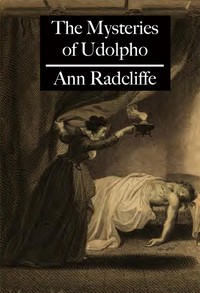
The Mysteries of Udolpho
first published 1794 · free to read
length
290,238 words
a few pages a day
~8 min
finished in
153 days
full read
20h 9m
At Folio's default of ten pages a day, you finish The Mysteries of Udolpho in about 153 days — roughly 8 minutes of reading each morning.
The opening
the first pages of The Mysteries of Udolpho, free
Fate sits on these dark battlements, and frowns, And, as the portals open to receive me, Her voice, in sullen echoes through the courts, Tells of a nameless deed.
VOLUME 1
CHAPTER I
home is the resort Of love, of joy, of peace and plenty, where, Supporting and supported, polish’d friends And dear relations mingle into bliss. THOMSON
On the pleasant banks of the Garonne, in the province of Gascony, stood, in the year 1584, the château of Monsieur St. Aubert. From its windows were seen the pastoral landscapes of Guienne and Gascony stretching along the river, gay with luxuriant woods and vine, and plantations of olives. To the south, the view was bounded by the majestic Pyrenees, whose summits, veiled in clouds, or exhibiting awful forms, seen, and lost again, as the partial vapours rolled along, were sometimes barren, and gleamed through the blue tinge of air, and sometimes frowned with forests of gloomy pine, that swept downward to their base. These tremendous precipices were contrasted by the soft green of the pastures and woods that hung upon their skirts; among whose flocks, and herds, and simple cottages, the eye, after having scaled the cliffs above, delighted to repose. To the north, and to the east, the plains of Guienne and Languedoc were lost in the mist of distance; on the west, Gascony was bounded by the waters of Biscay.
M. St. Aubert loved to wander, with his wife and daughter, on the margin of the Garonne, and to listen to the music that floated on its waves. He had known life in other forms than those of pastoral simplicity, having mingled in the gay and in the busy scenes of the world; but the flattering portrait of mankind, which his heart had delineated in early youth, his experience had too sorrowfully corrected. Yet, amidst the changing visions of life, his principles remained unshaken, his benevolence unchilled; and he retired from the multitude “more in pity than in anger,” to scenes of simple nature, to the pure delights of literature, and to the exercise of domestic virtues.
He was a descendant from the younger branch of an illustrious family, and it was designed, that the deficiency of his patrimonial wealth should be supplied either by a splendid alliance in marriage, or by success in the intrigues of public affairs. But St. Aubert had too nice a sense of honour to fulfil the latter hope, and too small a portion of ambition to sacrifice what he called happiness, to the attainment of wealth. After the death of his father he married a very amiable woman, his equal in birth, and not his superior in fortune. The late Monsieur St. Aubert’s liberality, or extravagance, had so much involved his affairs, that his son found it necessary to dispose of a part of the family domain, and, some years after his marriage, he sold it to Monsieur Quesnel, the brother of his wife, and retired to a small estate in Gascony, where conjugal felicity, and parental duties, divided his attention with the treasures of knowledge and the illuminations of genius.
To this spot he had been attached from his infancy. He had often made excursions to it when a boy, and the impressions of delight given to his mind by the homely kindness of the grey-headed peasant, to whom it was intrusted, and whose fruit and cream never failed, had not been obliterated by succeeding circumstances. The green pastures along which he had so often bounded in the exultation of health, and youthful freedom—the woods, under whose refreshing shade he had first indulged that pensive melancholy, which afterwards made a strong feature of his character—the wild walks of the mountains, the river, on whose waves he had floated, and the distant plains, which seemed boundless as his early hopes—were never after remembered by St. Aubert but with enthusiasm and regret. At length he disengaged himself from the world, and retired hither, to realise the wishes of many years.
The building, as it then stood, was merely a summer cottage, rendered interesting to a stranger by its neat simplicity, or the beauty of the surrounding scene; and considerable additions were necessary to make it a comfortable family residence. St. Aubert felt a kind of affection for every part of the fabric, which he remembered in his youth, and would not suffer a stone of it to be removed, so that the new building, adapted to the style of the old one, formed with it only a simple and elegant residence. The taste of Madame St. Aubert was conspicuous in its internal finishing, where the same chaste simplicity was observable in the furniture, and in the few ornaments of the apartments, that characterised the manners of its inhabitants.
Keep going from exactly here — Folio remembers your place and serves the next portion tomorrow.
continue reading The Mysteries of UdolphoAbout this free edition
The Mysteries of Udolpho by Ann Radcliffe (1764-1823) is free to read in full. Folio serves it in daily portions you can actually finish, tracks your streak and reading position across devices, and reads every page aloud with a built-in narrator. The text comes from Project Gutenberg.
More like The Mysteries of Udolpho
Dracula
Bram Stoker
The Strange Case of Dr. Jekyll and Mr. Hyde
Robert Louis Stevenson
The Turn of the Screw
Folio
The Turn of the Screw
Henry James

The Picture of Dorian Gray
Oscar Wilde
The Fall of the House of Usher
Folio
The Fall of the House of Usher
Edgar Allan Poe
Carmilla
Joseph Sheridan Le Fanu
Uncle Silas
Folio
Uncle Silas
Joseph Sheridan Le Fanu
The Castle of Otranto
Folio
The Castle of Otranto
Horace Walpole