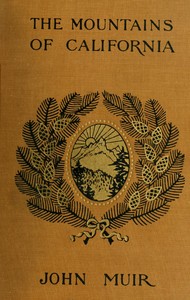
The Mountains of California
free to read
length
90,435 words
a few pages a day
~8 min
finished in
48 days
full read
6h 17m
At Folio's default of ten pages a day, you finish The Mountains of California in about 48 days — roughly 8 minutes of reading each morning.
The opening
the first pages of The Mountains of California, free
Go where you may within the bounds of California, mountains are ever in sight, charming and glorifying every landscape. Yet so simple and massive is the topography of the State in general views, that the main central portion displays only one valley, and two chains of mountains which seem almost perfectly regular in trend and height: the Coast Range on the west side, the Sierra Nevada on the east. These two ranges coming together in curves on the north and south inclose a magnificent basin, with a level floor more than 400 miles long, and from 35 to 60 miles wide. This is the grand Central Valley of California, the waters of which have only one outlet to the sea through the Golden Gate. But with this general simplicity of features there is great complexity of hidden detail. The Coast Range, rising as a grand green barrier against the ocean, from 2000 to 8000 feet high, is composed of innumerable forest-crowned spurs, ridges, and rolling hill-waves which inclose a multitude of smaller valleys; some looking out through long, forest-lined vistas to the sea; others, with but few trees, to the Central Valley; while a thousand others yet smaller are embosomed and concealed in mild, round-browed hills, each, with its own climate, soil, and productions.
Making your way through the mazes of the Coast Range to the summit of any of the inner peaks or passes opposite San Francisco, in the clear springtime, the grandest and most telling of all California landscapes is outspread before you. At your feet lies the great Central Valley glowing golden in the sunshine, extending north and south farther than the eye can reach, one smooth, flowery, lake-like bed of fertile soil. Along its eastern margin rises the mighty Sierra, miles in height, reposing like a smooth, cumulous cloud in the sunny sky, and so gloriously colored, and so luminous, it seems to be not clothed with light, but wholly composed of it, like the wall of some celestial city. Along the top, and extending a good way down, you see a pale, pearl-gray belt of snow; and below it a belt of blue and dark purple, marking the extension of the forests; and along the base of the range a broad belt of rose-purple and yellow, where lie the minor’s gold-fields and the foot-hill gardens. All these colored belts blending smoothly make a wall of light ineffably fine, and as beautiful as a rainbow, yet firm as adamant.
When I first enjoyed this superb view, one glowing April day, from the summit of the Pacheco Pass, the Central Valley, but little trampled or plowed as yet, was one furred, rich sheet of golden compositae, and the luminous wall of the mountains shone in all its glory. Then it seemed to me the Sierra should be called not the Nevada, or Snowy Range, but the Range of Light. And after ten years spent in the heart of it, rejoicing and wondering, bathing in its glorious floods of light, seeing the sunbursts of morning among the icy peaks, the noonday radiance on the trees and rocks and snow, the flush of the alpenglow, and a thousand dashing waterfalls with their marvelous abundance of irised spray, it still seems to me above all others the Range of Light, the most divinely beautiful of all the mountain-chains I have ever seen.
The Sierra is about 500 miles long, 70 miles wide, and from 7000 to nearly 15,000 feet high. In general views no mark of man is visible on it, nor anything to suggest the richness of the life it cherishes, or the depth and grandeur of its sculpture. None of its magnificent forest-crowned ridges rises much above the general level to publish its wealth. No great valley or lake is seen, or river, or group of well-marked features of any kind, standing out in distinct pictures. Even the summit-peaks, so clear and high in the sky, seem comparatively smooth and featureless. Nevertheless, glaciers are still at work in the shadows of the peaks, and thousands of lakes and meadows shine and bloom beneath them, and the whole range is furrowed with cañons to a depth of from 2000 to 5000 feet, in which once flowed majestic glaciers, and in which now flow and sing a band of beautiful rivers.
Keep going from exactly here — Folio remembers your place and serves the next portion tomorrow.
continue reading The Mountains of CaliforniaAbout this free edition
The Mountains of California by John Muir (1838-1914) is free to read in full. Folio serves it in daily portions you can actually finish, tracks your streak and reading position across devices, and reads every page aloud with a built-in narrator. The text comes from Project Gutenberg.
More like The Mountains of California
Stickeen
Folio
Stickeen
John Muir
The Story of My Boyhood and Youth
John Muir
My First Summer in the Sierra
John Muir
Travels in Alaska
John Muir

The Autobiography of Benjamin Franklin
Benjamin Franklin
Narrative of the Life of Frederick Douglass
Folio
Narrative of the Life of Frederick Douglass
Frederick Douglass
My Bondage and My Freedom
Folio
My Bondage and My Freedom
Frederick Douglass
The Story of My Life
Folio
The Story of My Life
Helen Keller