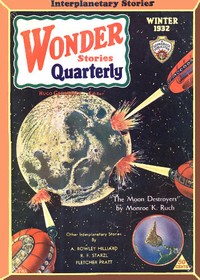
length
9,960 words
a few pages a day
~8 min
finished in
6 days
full read
42 min
At Folio's default of ten pages a day, you finish The Moon Destroyers in about 6 days — roughly 8 minutes of reading each morning.
The opening
the first pages of The Moon Destroyers, free
[Illustration: The tremendous speed of the dive brought them so close that they could see the skeletons of wrecked ships piled up at the base of the precipice.]
* * * * *
MONROE K. RUCH
The moon is not only the most prominent object in our heavens, but also an integral part of the earth. We are, so to speak, an astronomical unit, and we affect each other for better or for worse.
We know that the gravitational attraction of the moon causes our tides, and tends to slow up the earth in her daily rotation. It has also been deemed responsible for earthquakes, causing untold suffering among earth's people.
But so far the effect of the moon has been rather an inhuman affair. No man has gone to the moon to see just what conditions are there, and to observe accurately the influence that the moon and earth exercise over each other. But when interplanetary travel does come, when commerce between moon and earth may possibly assume importance in our lives, the influence of the moon upon us may be more accurately determined. And when it is, the amazing series of incidents, pictured in this story, may yet come true.
* * * * *
Professor Erickson, head of the International Seismographical Institute, sat with bowed head and pale face, watching the stylus of the instrument before him trace its path on the slowly revolving drum. The laboratory, situated high in the Himalayas, trembled slightly as mid-winter storms roared and whistled around it, but something quite different, and infinitely more sinister, was causing the needle to wander from its ordinarily straight path.
Suddenly, with horrible certainty, it jumped, wavered back and forth, and then moved rapidly to the right, until its black ink no longer traced a line on the white paper.
"Holden," shouted Erickson to his assistant, "what does the direction and distance finder tell us? The stylus has run clear off the graph."
Young Jack Holden was working feverishly over the dials and levers of the panel before him. Slender yet strong, he looked like a long-bow of stout old yew as he bent to the task. His steel gray eyes focused intently on the verniers, taking the readings. The muscles in his tanned cheeks were tight as he turned toward his superior. For a moment the very storm seemed to hush, awaiting the words. Then he spoke.
"It's the Laurentian fault!"
For a moment both men stared at each other, stunned and helpless.
"That means," Holden managed to say, "that New York is a mass of ruins."
Pictures were forming in his mind; he saw the huge steel and glass towers of the city, tossed and torn by the convulsive writhings of the earth beneath. Great engineers had said that the city was safe, that no tremors would ever disturb it, but they knew nothing of the terrific force of such a shock as this. Those massive buildings, thousands of feet high, would now be mere heaps of twisted junk. Holden closed his eyes to shut out the picture, but to no avail. His sister! God! She was probably one of the millions who now lay, crushed, bleeding and helpless beneath the wreckage of the too-proud metropolis.
"My boy," the professor was speaking, "we must stay with our work, no matter what happens." His voice was low; his entire family had been wiped out, without doubt, but Science must be served.
For hours the two sat before their instruments, as shock after shock was recorded. Jones came down from the television room above, and his report confirmed their observations in horrible detail.
Keep going from exactly here — Folio remembers your place and serves the next portion tomorrow.
continue reading The Moon DestroyersAbout this free edition
The Moon Destroyers by Monroe K. Ruch is free to read in full. Folio serves it in daily portions you can actually finish, tracks your streak and reading position across devices, and reads every page aloud with a built-in narrator. The text comes from Project Gutenberg.
More like The Moon Destroyers

The Time Machine
H. G. Wells

The War of the Worlds
H. G. Wells

The Invisible Man
H. G. Wells

The Island of Doctor Moreau
H. G. Wells
The First Men in the Moon
H. G. Wells
The Sleeper Awakes
Folio
The Sleeper Awakes
H. G. Wells
The Food of the Gods and How It Came to Earth
Folio
The Food of the Gods and How It Came to Earth
H. G. Wells

Frankenstein
Mary Shelley