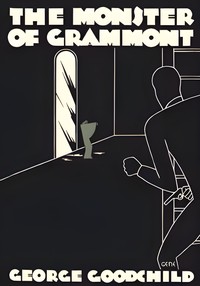
length
66,771 words
a few pages a day
~8 min
finished in
36 days
full read
4h 38m
At Folio's default of ten pages a day, you finish The monster of Grammont in about 36 days — roughly 8 minutes of reading each morning.
The opening
the first pages of The monster of Grammont, free
The bronzed, healthy-looking driver of the Bentley car put his foot harder on the accelerator pedal, and averted his head to hear the crackle of the exhaust as the sleek automobile sped along the undulating tree-lined Route Nationale. For the past three hours that white, arrow-like road had held his eyes, and he was “killing” it as fast as safety would permit, for main routes at the best were inclined to be monotonous.
While the speedometer needle wavered between the sixties and seventies his travelling companion was endeavouring to find their exact position on a large-scale French road map, a feat of considerable difficulty for which the execrable road surface was largely responsible.
“Steady, old man!” he said, as the wheels struck a deep cassis, causing a jarring of springs and a slight dither in the steering. “This isn’t Brooklands.”
“It’s about as unlovely. We’ll cut off at the next turning.”
Speed was reduced as bad pavé was encountered on the outskirts of a straggling village. It was exactly like a dozen others passed through that morning--two rows of tall, bare houses, with lime-washed walls and green shutters, a café, a comestible, and a pump surrounded by ample troughs, at which a few women were engaged in washing clothes. At the far end were two garages, each provided with a red petrol-pump bearing the familiar word “Essence,” the price in the one case being ten francs, and in the other ten francs fifty centimes, for what was precisely the same brand of fuel.
“Wonderful folk!” said the driver.
The car almost leaped the last ten yards of appalling pavé, and seemed to purr with satisfaction as the tyres found a better surface. On either hand sunlit fields stretched away to a hazy horizon, and here and there blue-bloused peasants were making the first hay. But periodically war-scars came to view, for it was the summer of 1920, and but a bare two years since the Germans made their last retreat that was to end five years of unmitigated horror.
The elder man folded up his map and placed it beside him. He was of smaller build than his young companion, and, judging from his face, of a more complaisant temperament. But, like the driver, he bore all the signs of abundant health and vitality. The pair had brought the car across the Channel a few days before, with the object of making a month’s tour of north and mid-France. No route had been laid down, and more often than not they slept in towns they had had no intention of visiting.
“Ralph!”
The driver averted his head.
“Turn left beyond the bridge. There’s a road that appears to go right through the forest.”
The car slowed down, and the acute bend was taken. Soon it was evident that the change of direction was justified. The first blush of summer lay over everything, and the dust-laden trees of the Route Nationale gave place to the rich, rain-washed hues of early June. The serpentine road became a joy, for it held surprises at every bend and pleaded for less speed and more appreciation.
Ralph Wallace banished his tense expression, and displayed his strong, white teeth in a smile. Speed-hog as he was, he was not so abandoned as not to be able to appreciate the natural joys of the quiet and refulgent by-ways. Lately he had had a surfeit of speed--a luxury that the straight roads of France offer to young “bloods” who own a ninety-miles-an-hour car.
“Give me a cigarette, Connie,” he begged.
Julian Conrad, the passenger, handed over the required article and lighted it in Wallace’s mouth, for the Bentley was now ambling along at a cycle pace. As Conrad turned his head one might have noticed a thin, straight scar extending from the corner of the left eye to the edge of the firm mouth. But the surgeon had made a neat job of it, and the sun had browned his skin to such an extent that this memento of the war could only be seen at close range.
Keep going from exactly here — Folio remembers your place and serves the next portion tomorrow.
continue reading The monster of GrammontAbout this free edition
The monster of Grammont by George Goodchild (1888-1969) is free to read in full. Folio serves it in daily portions you can actually finish, tracks your streak and reading position across devices, and reads every page aloud with a built-in narrator. The text comes from Project Gutenberg.
More like The monster of Grammont
The Adventures of Sherlock Holmes
Arthur Conan Doyle
The Hound of the Baskervilles
Arthur Conan Doyle
A Study in Scarlet
Folio
A Study in Scarlet
Arthur Conan Doyle
The Sign of the Four
Arthur Conan Doyle
The Memoirs of Sherlock Holmes
Arthur Conan Doyle

The Return of Sherlock Holmes
Arthur Conan Doyle
His Last Bow
Arthur Conan Doyle

The Valley of Fear
Arthur Conan Doyle