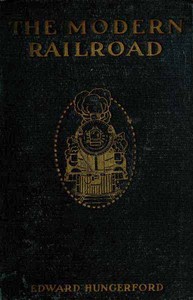
length
159,617 words
a few pages a day
~8 min
finished in
85 days
full read
11h 5m
At Folio's default of ten pages a day, you finish The Modern Railroad in about 85 days — roughly 8 minutes of reading each morning.
The opening
the first pages of The Modern Railroad, free
To bring to the great lay mind some slight idea of the intricacy and the involved detail of railroad operation is the purpose of this book. Of the intricacies and involved details of railroad finance and railroad politics; of the quarrels between the railroads, the organizations of their employees, the governmental commissions, or the shippers, it says little or nothing. These difficult and pertinent questions have been and still are being competently discussed by other writers.
The author wishes to acknowledge the courtesy of the editors and publishers of Harper's Monthly, Harper's Weekly, The Saturday Evening Post, and Outing in permitting the introduction into this work of portions or entire articles which he has written for them in the past. He would also feel remiss if he did not publish his sincere acknowledgments to "The American Railway," a compilation from Scribner's Magazine, published in 1887, Mr. Logan G. McPherson's "The Workings of the Railroad," Mr. C. F. Carter's "When Railroads Were New," and Mr. Frank H. Spearman's "The Strategy of Great Railroads." Out of a sizable reference library of railroad works, these volumes were the most helpful to him in the preparation of certain chapters of this book.
E. H.
BROOKLYN, NEW YORK, August 1, 1911.
CONTENTS
PAGE CHAPTER I
THE RAILROADS AND THEIR BEGINNINGS 1
Two great groups of railroads; East to West, and North to South--Some of the giant roads--Canals--Development of the country's natural resources--Railroad projects--Locomotives imported--First locomotive of American manufacture--Opposition of canal-owners to railroads--Development of Pennsylvania's anthracite mines--The merging of small lines into systems.
CHAPTER II
THE GRADUAL DEVELOPMENT OF THE RAILROAD 15
Alarm of canal-owners at the success of railroads--The making of the Baltimore & Ohio--The "Tom Thumb" engine--Difficulties in crossing the Appalachians--Extension to Pittsburgh--Troubles of the Erie Railroad--This road the first to use the telegraph--The prairies begin to be crossed by railways--Chicago's first railroad, the Galena & Chicago Union--Illinois Central--Rock Island, the first to span the Mississippi--Proposals to run railroads to the Pacific--The Central Pacific organized--It and the Union Pacific meet--Other Pacific roads.
CHAPTER III
THE BUILDING OF A RAILROAD 34
Cost of a single-track road--Financing--Securing a charter-- Survey-work and its dangers--Grades--Construction--Track-laying.
CHAPTER IV
TUNNELS 48
Their use in reducing grades--The Hoosac Tunnel--The use of shafts--Tunnelling under water--The Detroit River tunnel.
CHAPTER V
BRIDGES 56
Bridges of timber, then stone, then steel--The Starucca Viaduct--The first iron bridge in the United States--Steel bridges--Engineering triumphs--Different types of railroad bridge--The deck span and the truss span--Suspension bridges--Cantilever bridges--Reaching the solid rock with caissons--The work of "sand-hogs"--The cantilever over the Pend Oreille River--Variety of problems in bridge-building--Points in favor of the stone bridge--Bridges over the Keys of Florida.
CHAPTER VI
THE PASSENGER STATIONS 80
Early trains for suburbanites--Importance of the towerman-- Automatic switch systems--The interlocking machine--Capacities of the largest passenger terminals--Room for locomotives, car-storage, etc.--Storing and cleaning cars--The concourse-- Waiting-rooms--Baggage accommodations--Heating--Great development of passenger stations--Some notable stations in America.
CHAPTER VII
Keep going from exactly here — Folio remembers your place and serves the next portion tomorrow.
continue reading The Modern RailroadAbout this free edition
The Modern Railroad by Edward Hungerford (1875-1948) is free to read in full. Folio serves it in daily portions you can actually finish, tracks your streak and reading position across devices, and reads every page aloud with a built-in narrator. The text comes from Project Gutenberg.
More like The Modern Railroad
Our Railroads To-Morrow
Edward Hungerford
The Railroad Problem
Edward Hungerford
The Personality of American Cities
Edward Hungerford
The History of the Peloponnesian War
Folio
The History of the Peloponnesian War
Thucydides
The History of Herodotus
Folio
The History of Herodotus
Herodotus
The Gallic Wars
Folio
The Gallic Wars
Julius Caesar
Anabasis
Folio
Anabasis
Xenophon
The Lives of the Twelve Caesars
Folio
The Lives of the Twelve Caesars
Suetonius