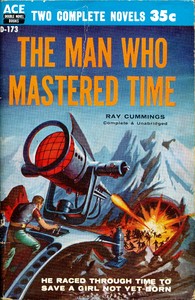
The Man Who Mastered Time
first published 1929 · free to read
length
55,209 words
a few pages a day
~8 min
finished in
30 days
full read
3h 50m
At Folio's default of ten pages a day, you finish The Man Who Mastered Time in about 30 days — roughly 8 minutes of reading each morning.
The opening
the first pages of The Man Who Mastered Time, free
"Quite so," agreed the Chemist. "And, gentlemen, that's not nearly so funny as it sounds. As a matter of fact, it is really not a bad scientific definition. Time and space are all that separate one event from another. Everything happens somewhere at sometime."
"You intimated you had something vitally important to tell us," the Big
Business Man suggested. "Something, Rogers, that would amaze us. Some project you were about to undertake--"
Rogers raised his hand. "In a moment, gentlemen. I want to prepare you first--to some extent, at least. That's why I have led you into this discussion. I want you to realize that your preconceived ideas of time are wrong, inadequate. You must think along entirely different lines, in terms of, I shall say, the new science."
"I will," agreed George, "only tell me how."
"You said that time, space, and matter are not separate, distinct entities, but are blended together," the Doctor declared. "Just what do you mean?"
Rogers gazed earnestly about the room. "This, my friends. Those are the three factors which make up our universe as we know it. I said they were blended. I mean that the actual reality underlying all the manifestations we experience is not temporal or spatial or material, but a blend of all three. It is we who, in our minds, have split up the original unity into three such supposedly different things as time, space and matter."
"Take space and time," said the Big Business Man. "Those two seem wholly different to me. I shouldn't think they had the slightest connection."
"But they have. Between the three planes of space--length, breadth and thickness--and time, there is no essential distinction. We think of them differently; we instinctively feel differently about them. But science is not concerned with our feelings--and science recognizes today that time is a property of space, just as are length, breadth and thickness."
"That's easy to say," growled the Banker. "Any one can make statements that can't be proven."
"It has been proven," Rogers declared quietly. "The mathematical language of science would bore you. Let me give you a popular illustration--an illustration, by the way, that I saw in print long before Einstein's theory was made public. For instance, think about this: A house has length, breadth and thickness. The house is matter, and it has three dimensions of space. But what else has it?"
A blank silence followed his sudden question.
"Hasn't it duration, gentlemen? Could a house have any real existence if it did not exist for any time at all?"
"Well," said George, "I guess that's something to think about."
Rogers went on calmly: "You must admit, my friends, that the existence of matter depends on time equally as on space. They are, as I said, blended together. A house must have length, breadth, thickness and duration, or it cannot exist. Matter, in other words, persists in time and space. Let me give you another illustration of this blending. How would you define motion?"
Again there was a dubious silence.
"Motion," said George suddenly, "why, that's when something--something material changes place." He was blushing at his own temerity, and he sat back in his leather chair, smoking furiously.
"Quite so," smiled Rogers. "That, gentlemen, is about the way we all conceive motion. Something material, a railroad train, for instance, changes its position in space." He regarded the men before him, and this time there was a touch of triumph in his manner. "But, my friends, that's where our line of reasoning is inadequate. Time is involved equally with space. The train was there then; it is here now. That involves time."
"In other words--" the Doctor began.
Keep going from exactly here — Folio remembers your place and serves the next portion tomorrow.
continue reading The Man Who Mastered TimeAbout this free edition
The Man Who Mastered Time by Ray Cummings (1887-1957) is free to read in full. Folio serves it in daily portions you can actually finish, tracks your streak and reading position across devices, and reads every page aloud with a built-in narrator. The text comes from Project Gutenberg.
More like The Man Who Mastered Time
The White Invaders
Folio
The White Invaders
Ray Cummings
The Girl in the Golden Atom
Folio
The Girl in the Golden Atom
Ray Cummings
Tarrano the Conqueror
Ray Cummings
The Fire People
Folio
The Fire People
Ray Cummings

The Princess of the Atom
Ray Cummings
Brigands of the Moon
Folio
Brigands of the Moon
Ray Cummings
Wandl the Invader
Folio
Wandl the Invader
Ray Cummings
Beyond the Vanishing Point
Folio
Beyond the Vanishing Point
Ray Cummings