length
42,540 words
a few pages a day
~8 min
finished in
23 days
full read
2h 57m
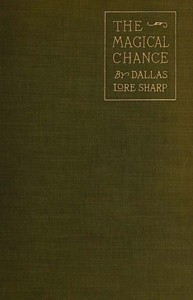
At Folio's default of ten pages a day, you finish The Magical Chance in about 23 days — roughly 8 minutes of reading each morning.
The opening
the first pages of The Magical Chance, free
“What are you going to say to the college girls?” my pretty niece asked, as we motored down the valley. She was being graduated this spring, and the snowy dogwoods and the purple Judas-trees against the tender hillsides were not so fresh, nor half so full of bloom, as she. But they were gayer far than she.
“Don’t tell them, uncle, how wonderful they are! How the world waits for them! Don’t say it, uncle! I have heard that sort of talk for these four years, and here I am with nobody waiting for me; not fitted for anything; nothing to do; and as wonderful--as thirty cents!”
Poor thing!
A few days before, I had seen an interview with the President of Yale, in which the young writer said he had read in a book that all the great devices had been invented; all the new lands explored; all the great deeds done--all the adventure and romance forever gone from life, and that only bread and butter remain with the odds against a young man’s getting much of the butter.
Poor thing!
Have I been living fifty years--in America? or fifty cycles in Cathay? I cannot still be young at fifty! nor can I be so old either as modern two-and-twenty! Youth is a dry tree, these days; a sad state--particularly youth bent with the burden of an A.B. degree. Out of my fifty-odd years of existence I have taught college youth for three-and-twenty, and never in all that time have they looked like plain bread and butter to me. If they are not adventure and romance, not better stories, sweeter songs, mightier deeds than any yet recorded, then I am no judge of story matter and the stuff of epic song.
But my pretty niece declares that she also knows a shoat when she sees one; and she knows it is just pork. As for the college man of the interview: he was not speaking by the book; out, rather, of the depths of his heart.
It is an evil thing to be born young into an old world!
For the world seems very old. Its face is covered with doubt, its heart is only ashes of burned-out fires. The River of Life which John saw has dwindled into Spoon River; and his Book of Life is now a novel, piddling and prurient. But John also saw the Scarlet Woman--and that was long ago! The world was ever much the same; ever in need of an Apocalypse; and never more in need than now. My pretty niece, and the young man of the interview, are the world, and the college world at that, the more’s the pity. They are its skepticism, its materialism, its conventionalism, its fear and failure. They seem afraid to bid on life, for fear it might be knocked off to them at something above par! They do not dare. They won’t take a chance. They would, of course, if there were chances; they would dare, if only one giant were still left stalking through the land. The giants are gone!
The orator was celebrating the hundredth anniversary of Richard Henry Dana, the author of “Two Years Before the Mast”:
Life offered him a magical human chance and he took it. There was something in him for which the decorous and conventional life of Boston allowed no place in its scheme. “Two Years Before the Mast” belongs to the Literature of Escape.
Life offered him a magical chance--as if he were a special case! So he was. So is every boy. Who was this boy? and what were the circumstances under which Life offered him this magical chance? He was a Bostonian to begin with, and that is bad enough; he was a Harvard undergraduate also, which still further complicates the situation; and, besides, he was a Dana! Here was a complex which should have staggered Life. Who could escape from all of this? Leave that to Life. Up she comes boldly, just as if she expected the boy to take her offer. And he did take it. He fell ill with some affliction of the eyes; and, going down to the Boston wharfs, shipped as a common sailor before the mast in the little brig Pilgrim for a two years’ trip around the Horn. And out of that escape from Boston and Harvard and the Danas, he brought back one of the three greatest sea stories in literature--a book that all of Boston and Harvard and the Danas combined could never have written except for this escape.
Keep going from exactly here — Folio remembers your place and serves the next portion tomorrow.
continue reading The Magical ChanceAbout this free edition
The Magical Chance by Dallas Lore Sharp (1870-1929) is free to read in full. Folio serves it in daily portions you can actually finish, tracks your streak and reading position across devices, and reads every page aloud with a built-in narrator. The text comes from Project Gutenberg.
More like The Magical Chance
Meditations
Folio
Meditations
Marcus Aurelius

The Enchiridion
Epictetus

Thus Spake Zarathustra
Friedrich Nietzsche
Beyond Good and Evil
Folio
Beyond Good and Evil
Friedrich Nietzsche
The Genealogy of Morals
Folio
The Genealogy of Morals
Friedrich Nietzsche
The Republic
Folio
The Republic
Plato
Apology
Folio
Apology
Plato
Crito
Folio
Crito
Plato