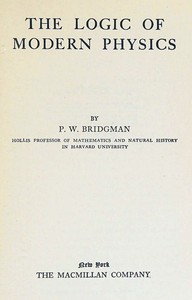
The logic of modern physics
free to read
length
61,146 words
a few pages a day
~8 min
finished in
33 days
full read
4h 15m
At Folio's default of ten pages a day, you finish The logic of modern physics in about 33 days — roughly 8 minutes of reading each morning.
The opening
the first pages of The logic of modern physics, free
This excursion into the field of fundamental criticism by one whose activities have hitherto been confined almost entirely to experiment is not evidence of senile decay, as might be cynically assumed. I have always, throughout all my experimental work, felt an imperative need of a better understanding of the foundations of our physical thought and have for a long time made more or less unsystematic attempts to reach such an understanding. Only now, however, has a half sabbatical year given me leisure to attempt a more or less orderly exposition.
In spite of previous writings on the broad fundamentals by Clifford, Stallo, Mach, and Poincaré, to mention only a few, I believe a new essay of this critical character needs no apology. For entirely apart from the question of whether many of the points of view of these essays can be maintained, the discovery of new facts in the domain of relativity and quantum theory has shifted the center of interest and emphasis. All the quite recent activity with the new quantum mechanics seems to call for a new examination of fundamental matters which shall recognize, at least by implication, the existence of the special phenomena of the quantum domain. However, the necessity for re-examination does not mean at all that many of the results of previous criticism may not still be accepted; some of these results have become so thoroughly incorporated into physical thinking that we can assume them without mention. Thus the fundamental attitude of this essay is empiricism, which is now justified as the attitude of the physicist in large part by the inquiry into the physiological origin of our concepts of space, time, and mechanics with which the previous essays were largely concerned.
None of the previous essays have consciously or immediately affected the details of this; in fact I have not read any of them within several years. If passages here recall passages already written, it is because the ideas have been assimilated and the precise origin forgotten; it is probably worth while to let such passages stand without revision, because such ideas gain in plausibility through having been found acceptable to independent thought.
I am much indebted to Professor R. F. Alfred Hoernlé of the Department of Philosophy of Johannesburg University, South Africa, for suggesting several modifications to make the text more acceptable to a philosopher, and slight amplifications for the benefit of readers not familiar with all the details of recent technical developments in physics.
INTRODUCTION
One of the most noteworthy movements in recent physics is a change of attitude toward what may be called the interpretative aspect of physics. It is being increasingly recognized, both in the writings and the conversation of physicists, that the world of experiment is not understandable without some examination of the purpose of physics and of the nature of its fundamental concepts. It is no new thing to attempt a more critical understanding of the nature of physics, but until recently all such attempts have been regarded with a certain suspicion or even sometimes contempt. The average physicist is likely to deprecate his own concern with such questions, and is inclined to dismiss the speculations of fellow physicists with the epithet "metaphysical." This attitude has no doubt had a certain justification in the utter unintelligibility to the physicist of many metaphysical speculations and the sterility of such speculations in yielding physical results. However, the growing reaction favoring a better understanding of the interpretative fundamentals of physics is not a pendulum swing of the fashion of thought toward metaphysics, originating in the upheaval of moral values produced by the great war, or anything of the sort, but is a reaction absolutely forced upon us by a rapidly increasing array of cold experimental facts.
Keep going from exactly here — Folio remembers your place and serves the next portion tomorrow.
continue reading The logic of modern physicsAbout this free edition
The logic of modern physics by P. W. Bridgman (1882-1961) is free to read in full. Folio serves it in daily portions you can actually finish, tracks your streak and reading position across devices, and reads every page aloud with a built-in narrator. The text comes from Project Gutenberg.
More like The logic of modern physics
Meditations
Folio
Meditations
Marcus Aurelius

The Enchiridion
Epictetus

Thus Spake Zarathustra
Friedrich Nietzsche
Beyond Good and Evil
Folio
Beyond Good and Evil
Friedrich Nietzsche
The Genealogy of Morals
Folio
The Genealogy of Morals
Friedrich Nietzsche
The Republic
Folio
The Republic
Plato
Apology
Folio
Apology
Plato
Crito
Folio
Crito
Plato