length
150,945 words
a few pages a day
~8 min
finished in
80 days
full read
10h 29m
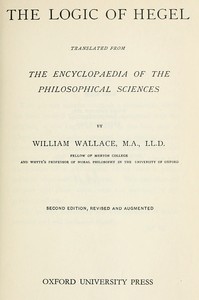
At Folio's default of ten pages a day, you finish The Logic of Hegel in about 80 days — roughly 8 minutes of reading each morning.
The opening
the first pages of The Logic of Hegel, free
THE ENCYCLOPAEDIA OF THE PHILOSOPHICAL SCIENCES IN OUTLINE is the third in time of the four works which Hegel published. It was preceded by the Phenomenology of Spirit, in 1807, and the Science of Logic (in two volumes), in 1812-16, and was followed by the Outlines of the Philosophy of Law in 1820. The only other works which came directly from his hand are a few essays, addresses, and reviews. The earliest of these appeared in the Critical Journal of Philosophy, issued by his friend Schelling and himself, in 1802--when Hegel was one and thirty, which, as Bacon thought, 'is a great deal of sand in the hour-glass'; and the latest were his contributions to the Jahrbücher für wissenschaftliche Kritik, in the year of his death (1831).
This Encyclopaedia is the only complete, matured, and authentic statement of Hegel's philosophical system. But, as the title-page bears, it is only an outline; and its primary aim is to supply a manual for the guidance of his students. In its mode of exposition the free flight of speculation is subordinated to the needs of the professorial class-room. Pegasus is put in harness. Paragraphs concise in form and saturated with meaning postulate and presuppose the presiding spirit of the lecturer to fuse them into continuity and raise them to higher lucidity. Yet in two directions the works of Hegel furnish a supplement to the defects of the Encyclopaedia.
One of these aids to comprehension is the Phenomenology of Spirit, published in his thirty-seventh year. It may be going too far to say with David Strauss that it is the Alpha and Omega of Hegel, and his later writings only extracts from it.[1] Yet here the Pegasus of mind soars free through untrodden fields of air, and tastes the joys of first love and the pride of fresh discovery in the quest for truth. The fire of young enthusiasm has not yet been forced to hide itself and smoulder away in apparent calm. The mood is Olympian--far above the turmoil and bitterness of lower earth, free from the bursts of temper which emerge later, when the thinker has to mingle in the fray and endure the shafts of controversy. But the Phenomenology, if not less than the Encyclopaedia it contains the diamond purity of Hegelianism, is a key which needs consummate patience and skill to use with advantage. If it commands a larger view, it demands a stronger wing of him who would join its voyage through the atmosphere of thought up to its purest empyrean. It may be the royal road to the Idea, but only a kingly soul can retrace its course.
The other commentary on the Encyclopaedia is supplied partly by Hegel's other published writings, and partly by the volumes (IX-XV in the Collected works) in which his editors have given his Lectures on the Philosophy of History, on Aesthetic, on the Philosophy of Religion, and on the History of Philosophy. All of these lectures, as well as the Philosophy of Law, published by himself, deal however only with the third part of the philosophic system. That system (p. 28) includes (i) Logic, (ii) Philosophy of Nature, and (iii) Philosophy of Spirit. It is this third part--or rather it is the last two divisions therein (embracing the great general interests of humanity, such as law and morals, religion and art, as well as the development of philosophy itself) which form the topics of Hegel s most expanded teaching. It is in this region that he has most appealed to the liberal culture of the century, and influenced (directly or by reaction) the progress of that philosophical history and historical philosophy of which our own generation is reaping the fast-accumulating fruit. If one may foist such a category into systematic philosophy, we may say that the study of the 'Objective' and 'Absolute Spirit' is the most interesting part of Hegel.
Keep going from exactly here — Folio remembers your place and serves the next portion tomorrow.
continue reading The Logic of HegelAbout this free edition
The Logic of Hegel by Georg Wilhelm Friedrich Hegel (1770-1831) is free to read in full. Folio serves it in daily portions you can actually finish, tracks your streak and reading position across devices, and reads every page aloud with a built-in narrator. The text comes from Project Gutenberg.
More like The Logic of Hegel
Hegel's Philosophy of Mind
Folio
Hegel's Philosophy of Mind
Georg Wilhelm Friedrich Hegel
Meditations
Folio
Meditations
Marcus Aurelius
The Enchiridion
Epictetus
Thus Spake Zarathustra
Friedrich Nietzsche
Beyond Good and Evil
Folio
Beyond Good and Evil
Friedrich Nietzsche
The Genealogy of Morals
Folio
The Genealogy of Morals
Friedrich Nietzsche
The Republic
Folio
The Republic
Plato
Apology
Folio
Apology
Plato