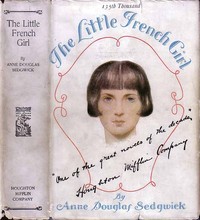
length
125,988 words
a few pages a day
~8 min
finished in
67 days
full read
8h 45m
At Folio's default of ten pages a day, you finish The Little French Girl in about 67 days — roughly 8 minutes of reading each morning.
The opening
the first pages of The Little French Girl, free
A clock struck eight, a loud yet distant clock. The strokes, Alix thought, seemed to glide downwards rather than to fall through the fog and tumult of the station, and, counting them as they emerged, they were so slow and heavy that they made her think of tawny drones pushing their way forth from among the thickets of hot thyme in the jardin potager at Montarel. Sitting straightly in her corner of the Victoria waiting-room, the little French girl fixed her mind upon the picture thus evoked so that she should not feel too sharply the alarming meaning of the hour, and seemed again to watch the blunt, sagacious faces of the drones as they paused in sulky deliberation on the tip of a spray before launching themselves into the sunlight. What could be more unlike Montarel than this cold and paltry scene? What more unlike that air, tranced with sunlight and silence, than this dense atmosphere? Yet the heavy, gliding notes brought back the drones so vividly that she found herself again in the high-terraced garden under the sun-baked old château. The magnolia-trees ate into the crumbling walls and opened lemon-scented cups beneath her as she leaned her arms on the hot stone and looked across the visionary plains to the Alps on the horizon, blue, impalpable, less substantial to the sight than the clouds that sailed in grandiose snowy fleets above them. Alix had always felt that it was like taking great breaths to see the plains and like spreading immense wings to see the mountains, and something of invulnerable dignity, of inaccessible remoteness in her demeanour as she sat there might well have been derived from generations who had lived and died in the presence of natural sublimities. Her brows were contemplative, her lips proud. She was evidently a foreigner, a creature nurtured in climes golden yet austere and springing from an aromatic, rocky soil. The pallor of her extreme fatigue could not efface the sunny tones of her skin; her hair was the blacker for its bronzed lights, and if her eyes were blue, it was not the English blue of a water-side forget-me-not, but the dense, impalpable blue of the Alps seen across great distances.
Two women, pausing on their way out to look at her, drew her mind back from Montarel. She knew that she might look younger than her years. Her bobbed hair was cut straight across her forehead and her skirt displayed a childish length of leg. It was no wonder that, seeing her there, alone, they should speak of her with curiosity, perhaps with solicitude; for there was kindness in their eyes. But she did not like pity, and, drawing herself up more straightly, wrapping her arms in the scarf that muffled her shoulders, she fixed her eyes blankly above their heads until they had passed on. They were kind women; but very ugly. Like jugs. All the people that she had seen since landing on this day of grey and purple flesh-tones had made her think of the earthenware jugs that old Marthe used to range along her upper shelves in the little dark shop that stood on the turn of the road leading down from the château to the village. Their eyes were joyless yet untragic. Their clothes expressed no enterprise. She did not think that they could feel ecstasy, ever, or despair. Yet they were the people of Captain Owen, and she could not be really forgotten, for Captain Owen’s family were to come for her. It was only some mistake; but more than the strokes of the clock the women’s eyes had made her feel how late it was, how young she was, and how hungry.
Maman’s déjeuner, the long buttered petits pains with ham in them, she had eaten on the boat; and, far away, seen across the leaden waters of the November channel, was the bright petit déjeuner, in Paris that morning, and Maman before the wood fire, her beauty still clouded by sleep, sweet, sombre, and gay as only she could be, her russet locks tossed back and her white arms bare in the white woollen peignoir. “They will, I know, be good to my darling,” Maman had said, buttering her roll while Albertine brought in the coffee, “and keep her warm and well-fed through this hard winter.” Firmness and resource breathed from Maman. She knew what she was doing and Alix saw herself powerless in her hands. Yet she could read her, too. Even though she could not always interpret the words, she could always read Maman, and the meaning, as it were, of the sentence would come to her in a feeling rather than in an idea. She had felt that morning that Maman’s heart was not at ease. It was true that the Armistice had been signed but the other day, that the war was hardly over, and that everything would be more expensive than ever. It was true that she was going to friends, though to unknown friends; to the family of their dear Captain Owen, killed in battle only nine months ago. He had so often said that they must know his family, and it had been his mother who had written so kindly to say that Giles would meet her. But if all this were so natural, why had she felt that touch of artifice in Maman’s manner, that resource in her so many reasons? Perhaps they did not really want her. And perhaps there was some mistake and they did not expect her to-night. If no one came, what was she to do? She had only five shillings in her purse. The porter had placed her little box and her dressing-case on the seat beside her, and if no one came was she to sit on here all night, in the waiting-room, this horrid feeling, half hunger, half fear, gnawing at the pit of her stomach? “Dieu, que j’ai faim!” she thought; and as she now leaned back her head and closed her eyes, the sadness that flowed into her carried her far back to Montarel again and it was Grand-père that she saw, passing under the pollarded lime-trees with his dragging footsteps and looking down on the ground as he went, with no eyes for the climbing vineyards, no eyes for the plains, the river, the Alps; his short white beard and jutting nose giving him still the air of a commandant, high on his fortress; but so old, so ill, so poor and so despairing.
Keep going from exactly here — Folio remembers your place and serves the next portion tomorrow.
continue reading The Little French GirlAbout this free edition
The Little French Girl by Anne Douglas Sedgwick (1873-1935) is free to read in full. Folio serves it in daily portions you can actually finish, tracks your streak and reading position across devices, and reads every page aloud with a built-in narrator. The text comes from Project Gutenberg.
More like The Little French Girl
Pride and Prejudice
Jane Austen
Sense and Sensibility
Jane Austen
Emma
Folio
Emma
Jane Austen
Persuasion
Folio
Persuasion
Jane Austen
Mansfield Park
Folio
Mansfield Park
Jane Austen

Jane Eyre
Charlotte Brontë
The Tenant of Wildfell Hall
Folio
The Tenant of Wildfell Hall
Anne Brontë
Agnes Grey
Folio
Agnes Grey
Anne Brontë