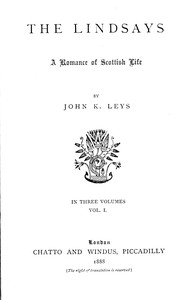
length
40,352 words
a few pages a day
~8 min
finished in
22 days
full read
2h 48m
At Folio's default of ten pages a day, you finish The Lindsays in about 22 days — roughly 8 minutes of reading each morning.
The opening
the first pages of The Lindsays, free
I only arrived here last night, so you see I am losing no time in redeeming my promise. I can hardly tell you what I think of my new cousins; they are not to be known in a day, I can see that much. As for the country and its inhabitants generally--well, they are as different from an English county and English country-folks as if they were in different continents, and that is all I can say at present.
I left the railway at a tiny station called Kilmartin, and found ‘the coach’ waiting in the station yard. It was not a coach, but a queer dumpy omnibus, about two-thirds of the size of a London ’bus, with three big, raw-boned horses harnessed to it. I was lucky enough to get a seat in front beside the driver. It was just a little before sunset; and I wish I could put before you in words the freshness of the scene. We were ascending a rising ground in a very leisurely fashion. On either side of the road was a steep bank thickly clothed with crowsfoot and wild thyme. Above us on either side stretched a belt of Scotch firs. The sunset rays shone red on the trunks of the pines, and here and there one could catch through them a sight of the ruddy west, showing like a great painted window in a cathedral. The air was soft, and laden with the sweet smell of the firs, and yet it was cool and exhilarating.
As soon as we got to the top of the ridge we began to rattle down the other side at a great rate. It was really very pleasant, and thinking to conciliate the weather-beaten coachman at my side, I confided to him my opinion that of all species of travelling coaching was the most delightful.
‘Specially on a winter’s nicht, wi’ yer feet twa lumps o’ ice, an’ a wee burn o’ snaw-watter runnin’ doon the nape o’ yer neck!’ responded the Scotch Jehu.
I laughed, and glanced at the man sitting on my right, a big, brown-faced, gray-haired farmer, in a suit of heavy tweeds, who sat leaning his two hands on the top of an enormous stick. He was smiling grimly to himself, as if he enjoyed the stranger being set down.
‘Fine country,’ I remarked, by way of conciliating him.
‘Ay,’ said he, with a glance at the horizon out of the sides of his eyes, but without moving a muscle of his face.
‘And a very fine evening,’ I persisted.
‘Ay--micht be waur.’
Upon this I gave it up, lighted a cigar, and set myself to study the landscape. We had got to a considerable elevation above the sea-level; and in spite of the glorious evening and the autumn colours just beginning to appear in the hedges, the country had a dreary look. Imagine one great stretch of pasture barely reclaimed from moorland, with the heather and stony ground cropping up every here and there, divided into fields, not by generous spreading hedgerows, but by low walls of blue stone, built without mortar. The only wood to be seen was narrow belts of firs, planted here and there behind a farmhouse, or between two fields, and somehow their long bare stems and heavy mournful foliage did not add to the brightness of the scene, though they gave it a character of its own. But the country is not all moor and pasture. It is broken every now and then by long, deep, winding ravines, clothed with the larch and the mountain ash, each one the home of a bright brawling stream.
We had travelled for half an hour in silence, when the farmer suddenly spoke.
‘Ye’ll be frae the sooth, I’m thinkin’.’
He was not looking at me, but contemplating the road in front of us from under a pair of the bushiest eyebrows I ever saw. For a moment I thought of repaying his bad manners by giving him no answer, but thinking better of it I said ‘Ay,’ after the manner of the country.
‘Ye’ll no hae mony beasts like they in England, I fancy,’ said he.
We were passing some Ayrshire cows at the time, small, but splendid animals of their kind; and I soothed the old man’s feelings by admitting the fact.
‘Are ye traivellin’ faur?’ he asked.
‘Not much farther, I believe.’
‘Ye’re no an agent, are ye?’
‘No,’ I answered.
‘Nor a factor?’
‘No.’
(He was evidently puzzled to make out what an Englishman was about in his country, and I determined not to gratify his curiosity.)
‘Ye’ll maybe be the doctor?’
‘No.’
‘Sharely ye’re no the new minister?’ he exclaimed with an expression of unfeigned alarm.
I calmed his fears, and again we proceeded on our way in silence.
Keep going from exactly here — Folio remembers your place and serves the next portion tomorrow.
continue reading The LindsaysAbout this free edition
The Lindsays by John K. Leys (1846-1909) is free to read in full. Folio serves it in daily portions you can actually finish, tracks your streak and reading position across devices, and reads every page aloud with a built-in narrator. The text comes from Project Gutenberg.
More like The Lindsays
Pride and Prejudice
Jane Austen
Sense and Sensibility
Jane Austen
Emma
Folio
Emma
Jane Austen
Persuasion
Folio
Persuasion
Jane Austen
Mansfield Park
Folio
Mansfield Park
Jane Austen
Jane Eyre
Charlotte Brontë
The Tenant of Wildfell Hall
Folio
The Tenant of Wildfell Hall
Anne Brontë
Agnes Grey
Folio
Agnes Grey
Anne Brontë