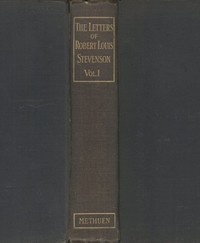
length
109,482 words
a few pages a day
~8 min
finished in
58 days
full read
7h 36m
At Folio's default of ten pages a day, you finish The Letters of Robert Louis Stevenson in about 58 days — roughly 8 minutes of reading each morning.
The opening
the first pages of The Letters of Robert Louis Stevenson, free
ONE day in the autumn of 1888, in the island of Tahiti, during an illness which he supposed might be his last, Stevenson put into the hands of his stepson, Mr. Lloyd Osbourne, a sealed paper with the request that it should be opened after his death. He recovered, as every one knows, and had strength enough to enjoy six years more of active life and work in the Pacific Islands. When the end came, and the paper was opened, it was found to contain, among other things, the expression of his wish that I should be asked to prepare for publication ‘a selection of his letters and a sketch of his life.’ The journal letters written to myself from his Samoan home, subsequently to the date of the request, offered the readiest material towards fulfilling promptly a part at least of the duty thus laid upon me; and a selection from these was accordingly published in the autumn following his death. {xv}
The scanty leisure of an official life (chiefly employed as it was for several years in seeing my friend’s collected and posthumous works through the press) did not allow me to complete the remainder of my task without considerable delay. For one thing, the body of correspondence which came in from various quarters turned out much larger than had been anticipated, and the labour of sifting and arranging it much greater. The author of Treasure Island and Across the Plains and Weir of Hermiston did not love writing letters, and will be found somewhere in the following pages referring to himself as one ‘essentially and originally incapable of the art epistolary.’ That he was a bad correspondent had even come to be an accepted view among his friends; but in truth it was only during one particular period of his life (see below, vol. i. p. 103) that he at all deserved such a reproach. At other times, as is now apparent, he had shown a degree of industry and spirit in letter-writing extraordinary considering his health and occupations, and especially considering his declared aversion for the task. His letters, it is true, were often the most informal in the world, and he generally neglected to date them, a habit which is the despair of editors; but after his own whim and fashion he wrote a vast number; so that for every one here included some half-a-dozen at least have had to be rejected.
In considering the scale and plan on which my friend’s instruction should be carried out, it seemed necessary to take into account, not his own always modest opinion of himself, but the place which, as time went on, he seemed likely to take ultimately in the world’s regard. The four or five years following the death of a writer much applauded in his lifetime are generally the years when the decline of his reputation begins, if it is going to suffer decline at all. At present, certainly, Stevenson’s name seems in no danger of going down. On the stream of daily literary reference and allusion it floats more actively than ever. In another sense its vitality is confirmed by the material test of continued sales and of the market. Since we have lost him other writers, whose beginnings he watched with sympathetic interest, have come to fill a greater immediate place in public attention; one especially has struck notes which appeal to dominant fibres in our Anglo-Saxon stock with irresistible force; but none has exercised Stevenson’s peculiar and personal power to charm, to attach, and to inspirit. By his study of perfection in form and style—qualities for which his countrymen in general have been apt to care little—he might seem destined to give pleasure chiefly to the fastidious and the artistically minded. But as to its matter, the main appeal of his work is not to any mental tastes and fashions of the few; it is rather to universal, hereditary instincts, to the primitive sources of imaginative excitement and entertainment in the race.
Keep going from exactly here — Folio remembers your place and serves the next portion tomorrow.
continue reading The Letters of Robert Louis StevensonAbout this free edition
The Letters of Robert Louis Stevenson by Robert Louis Stevenson (1850-1894) is free to read in full. Folio serves it in daily portions you can actually finish, tracks your streak and reading position across devices, and reads every page aloud with a built-in narrator. The text comes from Project Gutenberg.
More like The Letters of Robert Louis Stevenson
The Wrong Box
Folio
The Wrong Box
Robert Louis Stevenson
Treasure Island
Robert Louis Stevenson
Kidnapped
Robert Louis Stevenson
The Black Arrow
Folio
The Black Arrow
Robert Louis Stevenson
The Master of Ballantrae
Robert Louis Stevenson
Catriona
Folio
Catriona
Robert Louis Stevenson
St. Ives
Folio
St. Ives
Robert Louis Stevenson
Prince Otto
Folio
Prince Otto
Robert Louis Stevenson