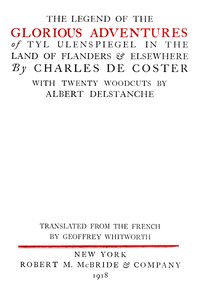
length
98,075 words
a few pages a day
~8 min
finished in
52 days
full read
6h 49m
At Folio's default of ten pages a day, you finish The Legend of Tyl Ulenspiegel in about 52 days — roughly 8 minutes of reading each morning.
The opening
the first pages of The Legend of Tyl Ulenspiegel, free
The book here offered in English to the English-speaking public has long been known and admired by students as the first and perhaps the most notable example of modern Belgian literature. Its author was born of obscure parentage in 1827, and, after a life passed in not much less obscurity, died in 1879. The ten years which were devoted to the composition of "The Legend of Tyl Ulenspiegel" were devoted to what proved, for de Coster, little more than a labour of love. Recognition came to him but from the few, and it was not till some thirty years after his death that an official monument was raised at Brussels to his memory, and an official oration delivered in his praise by Camille Lemonnier.
To the undiscerning among his contemporaries de Coster may have appeared little else than a rather eccentric journalist with archæological tastes. For a time, indeed, he held a post on the Royal Commission which was appointed in 1860 to investigate and publish old Flemish laws. And towards the end of his life he became a Professor of History and French Literature at the Military School in Brussels. Never, certainly, has a work of imagination, planned on an epic scale, been composed with a closer regard for historical detail than this Legend. But if our present age is less likely to be held by this than by those other qualities in the book of vitality and passion, it can only be that de Coster poured into his work not merely the knowledge and accuracy of an historian, but the love as well and the ardour of a poet and a patriot.
The objection--if it be an objection--that de Coster borrowed unblushingly from his predecessors need never be disputed. His style is frankly Rabelaisian. The stage whereon his actors play their parts is set, scene almost for scene, from the generally available documents that served such a writer as Thomas Motley for his "History of the Rise of the Dutch Republic." Even the name, the very lineaments of Ulenspiegel, are borrowed from that familiar figure of the sixteenth-century chap-books [1] whose jolly pranks and schoolboy frolics have been crystallized in the French word espièglerie, and in our own day set to music in one of the symphonic poems of Richard Strauss.
Yet from such well-worn ingredients de Coster's genius has mixed a potion most individually his own. The style of Rabelais is tempered with a finish, a neatness, and a wit that are as truly the product of the modern spirit as was the flamboyant jollity of Rabelais the product of his own Renaissance age; the sensible, historical foreground of a Motley becomes the coloured background to a romantic drama of human vice and virtue, linked in its turn to a conception of the cosmic process which has no other home, surely, than in the author's brain. While Ulenspiegel himself is now not simply the type of young high spirits and animal good humour, but a being as complex, as many-sided almost as humanity--all brightness of intellect, all warmth of heart, all honour, and all dream--the immortal Spirit of Flanders that knows not what it is to be beaten, whose last song must for ever remain unsung.
What shall we say of those other homely personages who fill the scene--symbols no less of Flemish character at its finest and of the enduringly domestic springs of Flemish national life? Claes the trusty fatherhood, Soetkin the valiant motherhood of Flanders, Nele her true heart, Lamme Goedzak her great belly that hungers always for more and yet more good things to eat and is never satisfied? Or what, again, of the tragic Katheline, half witch, half martyr, and the centre of that dark intrigue which seems to throb like a shuttle through the mazy pattern of the plot, threading it all into unity?
Keep going from exactly here — Folio remembers your place and serves the next portion tomorrow.
continue reading The Legend of Tyl UlenspiegelAbout this free edition
The Legend of Tyl Ulenspiegel by Charles de Coster (1827-1879) is free to read in full. Folio serves it in daily portions you can actually finish, tracks your streak and reading position across devices, and reads every page aloud with a built-in narrator. The text comes from Project Gutenberg.
More like The Legend of Tyl Ulenspiegel
Treasure Island
Robert Louis Stevenson
Kidnapped
Robert Louis Stevenson
The Call of the Wild
Jack London
White Fang
Jack London
The Sea-Wolf
Jack London
The Count of Monte Cristo
Alexandre Dumas
The Three Musketeers
Folio
The Three Musketeers
Alexandre Dumas
Robinson Crusoe
Folio
Robinson Crusoe
Daniel Defoe