length
73,089 words
a few pages a day
~8 min
finished in
39 days
full read
5h 5m
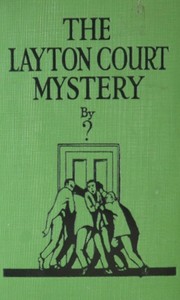
At Folio's default of ten pages a day, you finish The Layton Court mystery in about 39 days — roughly 8 minutes of reading each morning.
The opening
the first pages of The Layton Court mystery, free
I know of nobody who likes a detective story more than you do, with the possible exception of myself. So if I write one and you read it, we ought to be able to amuse ourselves at any rate.
I hope you will notice that I have tried to make the gentleman who eventually solves the mystery behave as nearly as possible as he might be expected to do in real life. That is to say, he is very far removed from a sphinx and he does make a mistake or two occasionally. I have never believed very much in those hawk-eyed, tight-lipped gentry, who pursue their silent and inexorable way straight to the heart of things without ever once overbalancing or turning aside after false goals; and I cannot see why even a detective story should not aim at the creation of a natural atmosphere, just as much as any other work of the lighter fiction.
In the same way I should like you to observe that I have set down quite plainly every scrap of evidence just as it is discovered, so that the reader has precisely the same data at his disposal as has the detective. This seems to me the only fair way of doing things. To hold up till the last chapter some vital piece of evidence (which, by the way, usually renders the solution of the puzzle perfectly simple), and to achieve your surprise by allowing the detective to arrest his man before the evidence on which he is doing so is ever so much as hinted to the reader at all, is, to my mind, most decidedly not playing the game.
With which short homily, I hand the book over to you by way of some very slight return for all that you have done for me.
Chapter I
Eight o’Clock in the Morning
William, the gardener at Layton Court, was a man of melancholy deliberation.
It did not pay, William held, to rush things; especially the important things of life, such as the removal of greenfly from roses. Before action was taken, the matter should be studied, carefully and unhappily, from every possible point of view, particularly the worst.
On this summer’s morning William had been gazing despondently at the roses for just over three quarters of an hour. Pretty soon now he would feel himself sufficiently fortified to begin operations on them.
“Do you always count the greenfly before you slaughter them, friend William?” asked a sudden voice behind him.
William, who had been bending forward to peer gloomily into the greenfly-blown intricacies of a Caroline Testout, slewed hastily about. He hated being accosted at the best of times, but there was a spontaneous heartiness about this voice which grated intolerably on all his finer feelings. The added fact that the act of slewing hastily about had brought a portion of his person into sharp and painful contact with another rose bush did not tend to make life any more cheerful for William at that moment.
“Weren’t a-countin’ em,” he observed curtly; and added naughtily under his breath, “Drat that there Mr. Sheringham!”
“Oh! I thought you must be totting up the bag in advance,” remarked the newcomer gravely from behind an enormous pipe. “What’s your record bag of greenfly, William? Runs into thousands of brace, I suppose. Well, no doubt it’s an interesting enough sport for people of quiet tastes. Like stamp-collecting. You ever collect stamps, William?”
“Noa,” said William, gazing sombrely at a worm. William was not one of your chatty conversationalists.
“Really?” replied his interlocutor with interest. “Mad on it myself once. As a boy, of course. Silly game though, really, I agree with you.” He followed the direction of William’s eyes. “Ah, the early morning worm!” he continued brightly. “And defying all the rules of its calling by refusing to act as provender for the early bird. Highly unprofessional conduct! There’s a lesson for all of us in that worm, William, if I could only think what it is. I’ll come back and tell you when I’ve had time to go into the matter properly.”
Keep going from exactly here — Folio remembers your place and serves the next portion tomorrow.
continue reading The Layton Court mysteryAbout this free edition
The Layton Court mystery by Anthony Berkeley (1893-1971) is free to read in full. Folio serves it in daily portions you can actually finish, tracks your streak and reading position across devices, and reads every page aloud with a built-in narrator. The text comes from Project Gutenberg.
More like The Layton Court mystery

The mystery at lovers' cave
Anthony Berkeley

The amateur crime
Anthony Berkeley

The poisoned chocolates case
Anthony Berkeley

The Adventures of Sherlock Holmes
Arthur Conan Doyle

The Hound of the Baskervilles
Arthur Conan Doyle
A Study in Scarlet
Folio
A Study in Scarlet
Arthur Conan Doyle

The Sign of the Four
Arthur Conan Doyle

The Memoirs of Sherlock Holmes
Arthur Conan Doyle