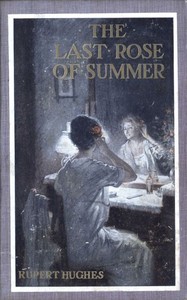
The Last Rose of Summer
free to read
length
12,284 words
a few pages a day
~8 min
finished in
7 days
full read
51 min
At Folio's default of ten pages a day, you finish The Last Rose of Summer in about 7 days — roughly 8 minutes of reading each morning.
The opening
the first pages of The Last Rose of Summer, free
As Mrs. Shillaber often said, the one good thing about her old house was the fact that "you could throw the dining-room into the poller" when you wanted to give parties or funerals or weddings or such things. You had only to fold up the accordeon-pleated doors, push the sofa back against the wall, and lay a rug over the register.
To-night she had thrown the dining-room into the poller and filled both rooms with guests. There were so many guests that they occupied every seat in the house, including the up-stairs chairs and a large batch of camp-stools from Mr. Crankshaw's, the undertaker's.
In Carthage it was never a real party or an important funeral unless those perilous old man-traps of Mr. Crankshaw's appeared. They always added a dash of excitement to the dullest evening, for at a critical moment one of them could be depended upon to collapse beneath some guest, depositing him or her in a small but complicated woodpile on the floor.
Less dramatic, but even droller, was the unfailing spectacle of the solemn man who entered a room carrying one of these stools neatly folded, proceeded to a chosen spot, and there attempted vainly to open the thing. This was sure to happen at least once, and it gave an irresistibly light touch even to the funerals. The obstinacy of some of Mr. Crankshaw's camp-stools was so diabolic that it almost implied a perverse intelligence. And the one that was not to be solved generally fell to the solemnest man in the company.
To-night at Mrs. Shillaber's the evening might be said to be well under way; fat Mr. Geggat had already splashed through his camp-stool, and Deacon Peavey was now at work on his; a snicker had just sneezed out of the minister's wife (of all people!), and the Deacon himself had breathed an expletive dangerously close to profanity.
The party was held in honor of Mrs. Shillaber's girlhood friend, Birdaline Nickerson (now Mrs. Phineas Duddy). Birdaline and Mrs. Shillaber (then Josie Barlow) had been fierce rivals for the love of Asaph Shillaber. Josie had got him away from Birdaline, and Birdaline had married Phin Duddy for spite, just to show certain people that Birdaline could get married as well as other people and to prove that Phin Duddy was not inconsolable for losing Josie, whom he had courted before Asaph cut him out.
Luck had smiled on Birdaline and Phin. They had moved away-to Peoria, no less! And now they were back on a visit to his folks.
When Birdaline saw what Time had done to Asaph she forgave Josie completely. It was Josie who did not forgive Birdaline, for Peoria had done wonders for Phin. Everybody said that; and Birdaline also brought along a grown-up daughter who was evidently beautiful and, according to her mother, highly accomplished. Why, one of the leading vocal teachers in Peoria (and very highly spoken of in Chicago) had heard her sing and had actually told her that she ought to have her voice cultivated; he had, indeed; fact was he had even offered to cultivate it himself, and at a reduced rate from his list price, too!
It seemed strange to Birdaline and Josie to meet after all these years and be jealous, not of each other, but of daughters as big as they themselves had been the last time they had seen each other. Both women told both women that they looked younger than ever, and each saw the pillage of time in the opposite mien, the accretion of time in the once so gracile figure. It was melancholy satisfaction at best, for each knew all too well how her own mirror slapped her in the face with her own image.
When Birdaline bragged of her daughter's voice, Josie had to be loyal to her oldest girl's own piano-playing. Birdaline, perhaps with serpentine wisdom, insisted on hearing Miss Shillaber play the piano; it was sure, she thought, to render the girl unpopular. But the solo annoyed the guests hardly at all, for they could easily talk above the feeble clamor of that old Shillaber piano, in which even the needy Carthage tuner had refused to twist another wrest-pin these many years.
After the piano had ceased to spatter staccato discords, and people had applauded politely, of course Josie had to ask Birdaline's daughter to sing. And the girl, being of the new and rather startling school of manners which accedes without undue urging, blushingly consented, provided there was any music there that she could sing and some one would play her accompa'ment.
Keep going from exactly here — Folio remembers your place and serves the next portion tomorrow.
continue reading The Last Rose of SummerAbout this free edition
The Last Rose of Summer by Rupert Hughes (1872-1956) is free to read in full. Folio serves it in daily portions you can actually finish, tracks your streak and reading position across devices, and reads every page aloud with a built-in narrator. The text comes from Project Gutenberg.
More like The Last Rose of Summer
The Dozen from Lakerim
Folio
The Dozen from Lakerim
Rupert Hughes
What Will People Say? A Novel
Rupert Hughes
Excuse Me!
Rupert Hughes
Contemporary American Composers
Folio
Contemporary American Composers
Rupert Hughes
Pride and Prejudice
Jane Austen

Sense and Sensibility
Jane Austen
Emma
Folio
Emma
Jane Austen
Persuasion
Folio
Persuasion
Jane Austen