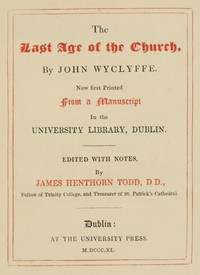
The last age of the church
free to read
length
12,098 words
a few pages a day
~8 min
finished in
7 days
full read
50 min
At Folio's default of ten pages a day, you finish The last age of the church in about 7 days — roughly 8 minutes of reading each morning.
The opening
the first pages of The last age of the church, free
A well known popular Writer on the History of the Christian Church has given it as his Opinion, that whoever will carefully examine the original Records, will soon be convinced that the Merits of Wyclyffe, as a Reformer, have been considerably exaggerated.[1] How far this is true or not, the Writer of these Pages will not attempt to determine; but certain it is, that to “examine the original Records,” with a View to discover the real Doctrines and Opinions of Wyclyffe, is much more easily said than done; and the Reader who seeks for Satisfaction from the Biographers of the Reformer, or from the Historians of the Period, will soon be convinced that the original Records, and above all, the still remaining Writings of Wyclyffe and his Followers, have never been examined with the Care and Attention necessary for the Purpose of forming a just Estimate of his Opinions, and of the Merit of his Efforts at a Reformation of the Church.
The List of Wyclyffe’s Writings published by Bishop Bale, in his Work, Scriptorum Majoris Brytanniæ Catalogus[2], has been necessarily made the Basis of all that subsequent Writers have collected. It has been reprinted, with many useful additions, by the learned and indefatigable John Lewis[3], of whose Labours every Student must speak with Gratitude. Mr. Baber[4] also has done much towards assisting future Inquirers, by the very valuable List of the Reformer’s Writings that he has compiled. Here, however, we must stop; Mr. Vaughan’s Compilation[5] has not added much to our Knowledge of the Subject, nor can it be commended either for Accuracy or Learning; and Mr. Le Bas[6] does not profess to do more than follow his Predecessors. His humbler Task, however, has been executed with great Elegance and Judgment.
The Truth, therefore, is, that until the Works of Wyclyffe, real and supposititious, be collected and published, it is vain to talk of determining his Opinions, or fixing his real Merits as a Reformer; and it is with the Hope of directing Attention to this Subject that the following Tract is now printed. The learned Henry Wharton[7] was willing to believe that all the Writings of Wyclyffe might in his Time have been recovered: “omnia ~Wiclefi~ scripta,” he says, “in Anglia adhuc delitescere, et ex Bibliothecis nostris qua publicis qua privatis in lucem erui posse, lubenter crederem.” Perhaps we have still all the MSS. that existed in Wharton’s Time, and it may be still within our Power to rescue them from the Oblivion in which they have so long been suffered to remain. But the Chances of their Destruction are every Day becoming greater, and Delay in such an Enterprize is highly dangerous. It is true that many of these Documents will be found dry, and to the popular Reader uninteresting; buried in the barbarous Latinity of the Schools, or concealed under the perhaps still more obsolete English of the fourteenth Century. But they who would engage in such a Labour as the Publication of the Works of Wyclyffe, must be above the narrow Influences of modern Utilitarianism. They must keep in View a higher Field of Learning than comes within the Sphere of Mercantile Speculators in Literature, or Useful Knowledge Societies. They must feel that the Value of these Documents as Compositions, is but a secondary Object in their Publication; the great End must be the Discovery of Truth, and the Preservation of the Remains of an illustrious Character in our History. What nobler, what more imperishable Monument could the Gratitude of England raise to her first Reformer, than a complete and uniform Edition of his extant Writings?
The Editor is fully sensible that the Tract which is now for the first Time given to the public, is very far from being a favorable Specimen of the Works of Wyclyffe. But it commended itself for Publication on many Grounds: First, its Shortness. Secondly, its early Date; for it bears internal Evidence of having been composed in the Year 1356[8], and must, therefore, (if really by Wyclyffe,) have been the earliest of his Writings. Another Motive for publishing this Production is furnished by the Consideration, that, if it be genuine, it reveals to us a Fact not dwelt upon, so far as the Editor knows, by any of the Reformer’s Biographers; namely, the Connexion which existed between the earlier Doctrines of Wyclyffe, and the prophetical Speculations of the Beguins, circulated under the Name of the famous Abbot Joachim.
It remains, however, to be proved, that the Tract now printed is really Wyclyffe’s; and this, the Editor admits, seemed to him an additional Reason for selecting it for Publication; inasmuch as it served at once to raise the Question, How far we have certain Grounds for attributing to Wyclyffe the Writings that exist under his Name; nor is it perhaps too much to say, that this is a Subject which the learned World has never been in a Condition to consider fully. Yet there is no preliminary Question more deserving of Attention, if we would form a just Estimate of our Reformer’s Merits; for it must be evident to every reflecting Reader, that if we are in any Degree uncertain of the Genuineness of such Writings as are quoted under the Name of Wyclyffe, the Conclusions drawn from them, as to the Nature and Character of his Doctrines, must be in the same Degree uncertain, and destitute of Authority.
Keep going from exactly here — Folio remembers your place and serves the next portion tomorrow.
continue reading The last age of the churchAbout this free edition
The last age of the church by John Wycliffe (-1384) is free to read in full. Folio serves it in daily portions you can actually finish, tracks your streak and reading position across devices, and reads every page aloud with a built-in narrator. The text comes from Project Gutenberg.
More like The last age of the church
Meditations
Folio
Meditations
Marcus Aurelius
The Enchiridion
Epictetus
Thus Spake Zarathustra
Friedrich Nietzsche
Beyond Good and Evil
Folio
Beyond Good and Evil
Friedrich Nietzsche
The Genealogy of Morals
Folio
The Genealogy of Morals
Friedrich Nietzsche
The Republic
Folio
The Republic
Plato
Apology
Folio
Apology
Plato
Crito
Folio
Crito
Plato