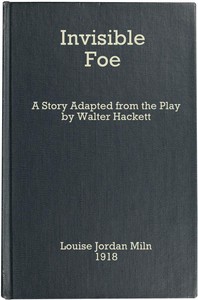
length
62,160 words
a few pages a day
~8 min
finished in
33 days
full read
4h 19m
At Folio's default of ten pages a day, you finish The Invisible Foe in about 33 days — roughly 8 minutes of reading each morning.
The opening
the first pages of The Invisible Foe, free
Stephen lay on his stomach, one sharp elbow comfortable in a velvet bed of moss, his chin cupped in his palm, his beautifully shaped head thrown back, his alert face lifted to the sky, his eager eyes following hungrily the flight of a bird.
Hugh, crunched up against the big oak tree, was making a chain of blossoms, and making it awkwardly enough, with many a restless boy-sigh, many a destruction of delicate spring wild flower.
Helen was playing by herself.
Nothing could have been more characteristic of the three children than their occupations of the moment.
Stephen usually was watching birds fly, when he was out of doors, and birds were to be seen. And the only time his uncle Richard had ever laid a hand (except in rare caress or in approbation) on the orphan boy, had been when Stephen, three months after his arrival at Deep Dale, had opened its cage, and lost Helen her pet canary—all because he “wanted to see just how he flies.”
“And I did see, too,” he had told Hugh an hour after his stoically endured caning. “It was worth more than a few smacks. Bet I can fly too, some day. You wait.”
Hugh had said nothing. He was used to Stephen and Stephen’s vivid ambitions. And he was stolid.
Stephen had suffered his slight chastisement proudly—if not quite gladly—but with each faltering fall of his uncle’s cane a seed of bitterness had entered the child’s soul. He never had felt the same to “Uncle Dick” since—which was no small pity, for the orphan boy was love-hungry, and Richard Bransby his best friend.
The small punishment bred deceit but worked no cure. The men in the fowl-yard could have told sad tales of staid hens aggravated to indignant, fluttering flight, and the old gardener of peacocks goaded to rise from their self-glorified strutting and preening to fly stiff and screaming the few spaces which were their farthest. But neither the farm hands nor the gardener told. Why—it is not easy to say. They did not particularly like Stephen—few people did. But they feared him. He mastered their wills. A solitary child, not half so happy as childhood has every right to be, the boy met few he did not influence sharply. His was a masterful nature. Little altogether escaped his subtle dominance.
Stephen was not essentially cruel. His cruelty was corollary and accessory to his passion—a passion for power and for the secrets of aerial skill. He bore the birds no ill-will. He simply was obsessed to see their flight, and to study it, garnering up in his odd, isolated, accretive child’s mind—and heart—every vibrant curve and beat of their wings, every angle and bend of their bodies.
Stephen usually was watching the flight of a bird, or scheming some mechanical imitation of it.
Hugh usually was doing something for wee Helen, doing it with perspiring and sighful awkwardness and for scant thanks—or for none.
Helen usually was playing by herself, and pretending, as now, to be sharing the sport of some playfellow, perfectly tangible to her, but invisible, non-existent to the boys—a form of persistent “make believe” which greatly amused Hugh and as greatly irritated Stephen.
“Don’t pretend like that; it’s a simpleton way of going on,” the older boy called to her now, without moving his head or his eyes.
Keep going from exactly here — Folio remembers your place and serves the next portion tomorrow.
continue reading The Invisible FoeAbout this free edition
The Invisible Foe by Louise Jordan Miln (1864-1933) is free to read in full. Folio serves it in daily portions you can actually finish, tracks your streak and reading position across devices, and reads every page aloud with a built-in narrator. The text comes from Project Gutenberg.
More like The Invisible Foe
The Adventures of Sherlock Holmes
Arthur Conan Doyle
The Hound of the Baskervilles
Arthur Conan Doyle
A Study in Scarlet
Folio
A Study in Scarlet
Arthur Conan Doyle
The Sign of the Four
Arthur Conan Doyle
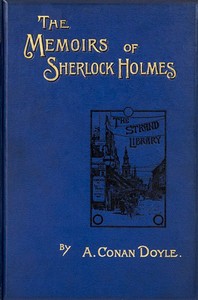
The Memoirs of Sherlock Holmes
Arthur Conan Doyle
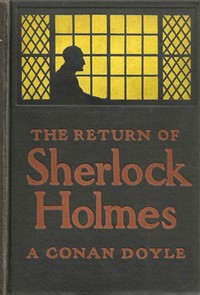
The Return of Sherlock Holmes
Arthur Conan Doyle
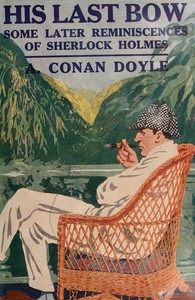
His Last Bow
Arthur Conan Doyle
The Valley of Fear
Arthur Conan Doyle