length
87,458 words
a few pages a day
~8 min
finished in
47 days
full read
6h 4m
At Folio's default of ten pages a day, you finish The Invention of Lithography in about 47 days — roughly 8 minutes of reading each morning.
The opening
the first pages of The Invention of Lithography, free
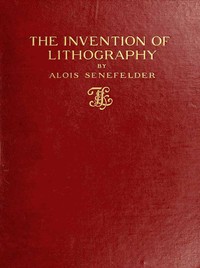
Alois Senefelder, not only the inventor, but the father and perfecter of Lithography, wrote this story of his life and his invention in 1817. The translator has followed his style closely, because he felt that the readers would prefer to have this English edition represent Senefelder's original German faithfully.
When Senefelder wrote, he had to invent many names for the processes, manipulation-methods, and tools. These terms have been translated literally even where modern practice has adopted other names.
The original German edition carried the following title-page:--
"COMPLETE | TEXT-BOOK OF STONE-PRINTING | CONTAINING | A CORRECT AND LUCID INSTRUCTION | FOR ALL | VARIOUS MANIPULATIONS IN ALL ITS BRANCHES AND METHODS | AND ALSO A | FULL HISTORY OF THIS ART | FROM ITS ORIGIN TO THE PRESENT DAY. | WRITTEN AND PUBLISHED | BY THE INVENTOR OF LITHOGRAPHY AND CHEMICAL PRINTING, | ALOIS SENEFELDER. | WITH A PREFACE BY THE GENERAL-SECRETARY OF THE ROYAL ACADEMY OF SCIENCES IN | MUNICH, THE DIRECTOR | FRIEDERICH VON SCHLICHTEGROLL | MUNICH, 1821 | OBTAINABLE FROM THE AUTHOR AND FROM E. A. FLEISCHMANN" |
The book was dedicated by Senefelder to Maximilian Joseph, then King of Bavaria.
July, 1911.
J. W. M.
PREFACE
A book like this requires no preface; it makes its own way, supported by its contents. But the famous author deems that his acquaintance with me gave him the direct impulse for producing this work, which has been desired so long and from all sides; and he wishes that I shall say something about the history of its production. I seize the opportunity gladly to prove the esteem and the friendship that the talent of this honorable contemporary and fellow countryman, a talent combined with the utmost ambition and with childlike good nature and unselfishness, have inspired in me.
One may not declare that his contemporaries showed indifference to the invention of lithography to which his fortunate star led Herr Alois Senefelder, and to the improvements that he sought with thousands of experiments and restless labor. On the contrary, the invention has spread itself with surprising speed through Europe and beyond, and has been received with admiration everywhere. But the lack of proper instruction, due to the many who had learned it only partially and introduced it only for the sake of a small, passing profit, has hampered its perfect success.
Therefore the inventor, who, happily, still lives among us, has been urged from near and far to tell the story of his important, many-sided discovery, and to give instructions for its use, that is, to produce such a work as is before us now.
But the artistic genius, full of his subject, would far rather work, experiment, strive, than write! Many times Herr Senefelder decided to set down how he happened on this art, how the successive steps of its development were reached, and at what point of development its various processes now stand; but always his ceaselessly striving spirit showed him something new that might be achieved, and forced him back again into his element,--experimentation.
Thus the "Pattern Book," begun in 1809, remained unfinished and without text; and the other work, announced two years ago by Herr Andre, in Offenbach, as being undertaken by him with Herr Alois Senefelder, hardly would have seen the light.
A forceful impetus from without was needed to compel Herr Senefelder to fulfill the general request of the public. It came as follows. Many statements in print attracted my attention. They credited the invention of lithography to Paris, to London; and in Munich there were various contradictory legends, some alleging that Herr Alois Senefelder had made the very first experiments and others crediting them to Herr Schmidt in Miesbach, at that time Professor in Munich. I considered it my duty to clear away this uncertainty and to prepare a critical history of this invention while it still was possible.
Keep going from exactly here — Folio remembers your place and serves the next portion tomorrow.
continue reading The Invention of LithographyAbout this free edition
The Invention of Lithography by Alois Senefelder (1771-1834) is free to read in full. Folio serves it in daily portions you can actually finish, tracks your streak and reading position across devices, and reads every page aloud with a built-in narrator. The text comes from Project Gutenberg.
More like The Invention of Lithography
The History of the Peloponnesian War
Folio
The History of the Peloponnesian War
Thucydides
The History of Herodotus
Folio
The History of Herodotus
Herodotus
The Gallic Wars
Folio
The Gallic Wars
Julius Caesar
Anabasis
Folio
Anabasis
Xenophon
The Lives of the Twelve Caesars
Folio
The Lives of the Twelve Caesars
Suetonius
Germania
Folio
Germania
Tacitus

The History of the Decline and Fall of the Roman Empire
Edward Gibbon
The Travels of Marco Polo
Marco Polo