length
13,318 words
a few pages a day
~8 min
finished in
8 days
full read
55 min
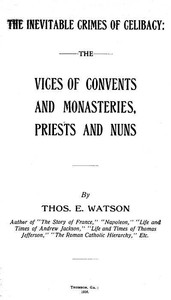
At Folio's default of ten pages a day, you finish The Inevitable Crimes of Celibacy in about 8 days — roughly 8 minutes of reading each morning.
The opening
the first pages of The Inevitable Crimes of Celibacy, free
When any species of wrong-doing can wear the disguise of righteousness, the blindest among us can see how dangerous that kind of crime may become--how hard to prove, punish and put down.
There are immense Arabian plains where nomad robbers have practised their profession, from a time whereof the memory of man runneth not to the contrary; yet those plains and the nomad bands that pitch their tents beneath the Oriental sun remain very much as they were in the days of Abraham.
But where robbery has disguised itself as Law, and one class has aimed the law-making machine at the others, saying "Stand and deliver!" whole regions have become deserts, and great peoples have been blotted out.
In fact, the highwayman, the cattle-lifter and the pickpocket have never in the least affected the destinies of nations. The pirate and the buccaneer have never been able to destroy the commerce of the seas, beggar provinces, and change noble harbors into neglected pools.
It is when the robbers intrench themselves in Parliaments, Reichstags and Congresses, and the robbery takes the form of "Law," that spoliation becomes destructive. Bank laws and money-contraction laws beat down more victims than armies. Protective Tariff "laws," infinitely more ruinous than all the Lafittes and Captain Kidds, drive the American flag from the seas, while on land they make a thousand Rockefellers, Carnegies, Morgans, Guggenheims, McCormicks and Armours, at the same time that they are casting millions of the despoiled out of house and home.
There are realms where religious mendicancy keeps to the primitive forms of the beggar's bowl and pouch. It is the free-will offering.
In these countries of voluntary tributes, religious feeling has branched into the fewest channels, has lost the least of its original force, and maintains today its most impregnable position. But where the priestly caste was able to intrench its mendicancy in Law, and arrogantly say to the laity, "Pay me one-tenth of all thou hast!" religion was first to well-nigh lose its beauty and its strength, and like, the Rhine, almost disappear into the intricate morasses of subdivisions.
Ten thousand virulent disputes about tithes ushered in the diabolisms of the French Revolution; and many of my readers will remember how Charles Dickens, when a Parliamentary reporter, dropped his pencil in tears, unable to go on, as Daniel O'Connell described one of the tragedies of a tithe-riot in Ireland.
When Religion went forth as Christ sent it forth, it demanded nothing for the priest. Yet, the same religion, organized into an episcopacy, afterwards wrote the tax of one-tenth upon the statute-book, and sold the widow's cow to pay the priest for his prayer. In those days, it must have been a gruesome spectacle as the burly parson, a picture of physical fullness, stood in the background, personifying Law and Religion, while the bailiff raided the cotter's wretched premises, pounced upon pigs and poultry, or dragged household goods off to public sale. Yet, during centuries of outrage, pain and starvation, this sort of robbery disguised itself with a double domino of Law and Religion.
Forgive me, if I digress briefly to mention how vividly I was reminded of all this, by the thrifty, business-like manner in which Bishop P. J. Donohue, of Wheeling, West Virginia, sold out a laboring man, S. W. Hawley, for rent, in the year of our Crucified Lord, 1913.
To satisfy the debt due to this most worshipful Bishop of God, the following personal property was seized, and advertised for sale, to-wit: 3 bed springs and 3 beds, 3 mattresses, 1 stove, 2 tables, 10 chairs, 3 pictures, 1 broom, 4 comforts, 2 blankets, 3 quilts, 4 pillows, and some dishes.
(It was further stated that Hawley's back was broken, while working in the coal mines.)
George Alfred Townsend, who was so well known to journalism as "Gath," wrote a novel which he called "The Entailed Hat." The book would have lived gloriously, had it not been for the hat: the sternly absurd conditions which this idea about the Entailed Hat fastened upon the author, killed his novel.
But there was in it one passage which lingers yet in my recollection, after the lapse of more than 30 years. There were two brothers, shrewd, pushing, flinty Jews, who drove hard bargains, hard collections, and filled a store-room with household plunder sold for debt, and bought in by the Jews, to be resold at a profit. "Gath" gave tongue to each article of this pitiful domestic furniture, torn from the homes of the poor, and auctioned at public outcry.
Keep going from exactly here — Folio remembers your place and serves the next portion tomorrow.
continue reading The Inevitable Crimes of CelibacyAbout this free edition
The Inevitable Crimes of Celibacy by Thomas E. Watson (1856-1922) is free to read in full. Folio serves it in daily portions you can actually finish, tracks your streak and reading position across devices, and reads every page aloud with a built-in narrator. The text comes from Project Gutenberg.
More like The Inevitable Crimes of Celibacy
Meditations
Folio
Meditations
Marcus Aurelius

The Enchiridion
Epictetus

Thus Spake Zarathustra
Friedrich Nietzsche
Beyond Good and Evil
Folio
Beyond Good and Evil
Friedrich Nietzsche
The Genealogy of Morals
Folio
The Genealogy of Morals
Friedrich Nietzsche
The Republic
Folio
The Republic
Plato
Apology
Folio
Apology
Plato
Crito
Folio
Crito
Plato