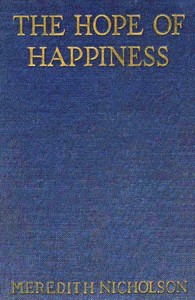
length
97,771 words
a few pages a day
~8 min
finished in
52 days
full read
6h 47m
At Folio's default of ten pages a day, you finish The hope of happiness in about 52 days — roughly 8 minutes of reading each morning.
The opening
the first pages of The hope of happiness, free
Bruce Storrs stood up tall and straight on a prostrate sycamore, the sunlight gleaming upon his lithe, vigorous body, and with a quick, assured lifting of the arms plunged into the cool depths of the river. He rose and swam with long, confident strokes the length of a pool formed by the curving banks and returned to the log, climbing up with the same ease and grace that marked his swimming. He dashed the water from his eyes and pressed his deeply-tanned hands over his shapely head. It was evident that he was the fortunate inheritor of clean blood in a perfectly fashioned body; that he had used himself well in his twenty-eight years and that he found satisfaction and pride in his health and strength. He surveyed the narrow valley through which the river idled and eddied before rushing into the broader channel beyond--surveyed it with something of the air of a discoverer who has found and appropriated to his own uses a new corner of the world.
It was a good place to be at the end of a day that was typical of late August in the corn belt, a day of intense dry heat with faint intimations on the horizon of the approach of autumn. With a contented sigh he sat down on the log, his feet drawn up, his shoulders bent, and aimlessly tore bits of bark from the log and tossed them into the water. Lulled by the lazy ripple, he yielded himself to reverie and his eyes filled with dreams as he stared unseeingly across the stream. Suddenly he raised his head resolutely as if his thoughts had returned to the world of the actual and he had reached a conclusion of high importance. He plunged again and now his short, rapid strokes threshed the water into foam. One might have thought that in the assertion of his physical strength he was testing and reassuring himself of his complete self-mastery.
Refreshed and invigorated, he clambered up the bank and sought a great beech by whose pillar-like trunk he had left his belongings, and proceeded to dress. From a flat canvas bag he produced a towel and a variety of toilet articles. He combed his thick curly hair, donned a flannel shirt and knotted a blue scarf under its soft collar. His shoes of brogan type bore the imprint of a metropolitan maker and his gray knickerbockers and jacket indicated a capable tailor.
He took from the bag a package of letters addressed in a woman’s hand to Bruce Storrs, and making himself comfortable with his back to the tree, he began to read. The letters had been subjected to many readings, as their worn appearance testified, but selecting the bulkiest, he perused it carefully, as though wishing to make sure that its phrases were firmly fixed in his memory.
“... Since my talk with you,” he read, “I have had less pain, but the improvement is only temporary--the doctors do not deceive me as to that. I may go quickly--any day, any hour. You heard my story the other night--generously, with a fine tolerance, as I knew you would. If I had not been so satisfied of your sense of justice and so sure of your love, I could never have told you. But from the hour I knew that my life was nearing its end I felt more and more that you must know. One or two things I’m afraid I didn’t make clear ... that I loved the man who is your father. Love alone could be my justification--without that I could never have lived through these years.
“The man you have called father never suspected the truth. He trusted me. It has been part of my punishment that through all these years I have had to endure the constant manifestations of his love and confidence. But for that one lapse in the second year of my marriage, I was absolutely faithful in all my obligations to him. And he was kind to you and proud of you. He did all for you that a father could, never dreaming that you were not his own. It was one of my sorrows that I couldn’t give him a child of his own. Things went badly with him in his last years, as you know, and what I leave to you--it will be about fifty thousand dollars--I inherited from my father, and it will help you find your place in the world.
“Your father has no idea of your existence.... Ours was a midsummer madness, at a time when we were both young. I only knew him a little while, and I have never heard from him. My love for him never wholly died. Please, dear, don’t think harshly of me, but there have been times when I would have given my life for a sight of him. After all you are his--his as much as mine. You came to me from him--strangely dear and beautiful. In my mind you have always been his, and I loved you the dearer. I loved him, but I could not bring myself to leave the man you have called father for him. He was not the kind of man women run away with....
Keep going from exactly here — Folio remembers your place and serves the next portion tomorrow.
continue reading The hope of happinessAbout this free edition
The hope of happiness by Meredith Nicholson (1866-1947) is free to read in full. Folio serves it in daily portions you can actually finish, tracks your streak and reading position across devices, and reads every page aloud with a built-in narrator. The text comes from Project Gutenberg.
More like The hope of happiness
The House of a Thousand Candles
Folio
The House of a Thousand Candles
Meredith Nicholson
The Port of Missing Men
Meredith Nicholson
Rosalind at Red Gate
Folio
Rosalind at Red Gate
Meredith Nicholson
The Madness of May
Folio
The Madness of May
Meredith Nicholson

Lady Larkspur
Meredith Nicholson
The Siege of the Seven Suitors
Folio
The Siege of the Seven Suitors
Meredith Nicholson
The Main Chance
Meredith Nicholson
The Little Brown Jug at Kildare
Meredith Nicholson