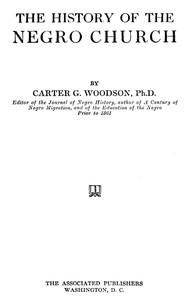
length
80,430 words
a few pages a day
~8 min
finished in
43 days
full read
5h 35m
At Folio's default of ten pages a day, you finish The History of the Negro Church in about 43 days — roughly 8 minutes of reading each morning.
The opening
the first pages of The History of the Negro Church, free
The importance of the church in the life of the Negro justifies the publication of this brief account of the development of the institution. For many years the various denominations have been writing treatises bearing on their own particular work, but hitherto there has been no effort to study the achievements of all of these groups as parts of the same institution and to show the evolution of it from the earliest period to the present time. This is the objective of this volume.
Whether or not the author has done this task well is a question which the public must decide. This work does not represent what he desired to make it. Many facts of the past could not be obtained for the reason that several denominations have failed to keep records and facts known to persons now active in the church could not be collected because of indifference or the failure to understand the motives of the author. Not a few church officers and ministers, however, gladly coöperated with the author in giving and seeking information concerning their denominations. Among these were Mr. Charles H. Wesley, Prof. J. A. Booker, and Dr. Walter H. Brooks. For their valuable assistance the author feels deeply grateful.
CARTER G. WOODSON.
Washington, D. C., September, 1921.
CONTENTS
CHAPTER PAGE
I.--Early Missionaries and the Negro 1 II.--The Dawn of the New Day 23 III.--Pioneer Negro Preachers 40 IV.--The Independent Church Movement 71 V.--Early Development 100 VI.--The Schism and the Subsequent Situation 123 VII.--Religious Instruction Revived 148 VIII.--Preachers of Versatile Genius 167 IX.--The Civil War and the Church 185 X.--Religious Education as a Preparation 202 XI.--The Call of Politics 220 XII.--The Conservative and Progressive 247 XIII.--The Negro Church Socialized 266 XIV.--The Recent Growth of the Negro Church 286 XV.--The Negro Church of To-day 300 FOOTNOTES INDEX
ILLUSTRATIONS
A Christianized African Frontispiece Directing the Wanderer in the right Way The Oldest Negro Baptist Church in the United States Lemuel Haynes Andrew Bryan Richard Allen James Varick Peter Williams Christopher Rush Lott Cary M. C. Clayton Sampson White Josiah Henson Noah Davis Samuel R. Ward Alexander Crummell J. W. C. Pennington Henry Highland Garnett Daniel A. Payne Richard DeBaptiste W. H. Miles Wilberforce During the Civil War William J. Simmons James Poindexter J. C. Price H. M. Turner B. W. Arnett W. B. Derrick J. W. Hood L. H. Holsey Rufus L. Perry Charles T. Walker John Jasper E. K. Love W. R. Pettiford M. C. B. Mason George W. Lee Alexander Walters
CHAPTER I
THE EARLY MISSIONARIES AND THE NEGRO
One of the causes of the discovery of America was the translation into action of the desire of European zealots to extend the Catholic religion into other parts. Columbus, we are told, was decidedly missionary in his efforts and felt that he could not make a more significant contribution to the church than to open new fields for Christian endeavor. His final success in securing the equipment adequate to the adventure upon the high seas was to some extent determined by the Christian motives impelling the sovereigns of Spain to finance the expedition for the reason that it might afford an opportunity for promoting the cause of Christ. Some of the French who came to the new world to establish their claims by further discovery and exploration, moreover, were either actuated by similar motives or welcomed the coöperation of earnest workers thus interested.
The first persons proselyted by the Spanish and French missionaries were Indians. There was not any particular thought of the Negro. It may seem a little strange just now to think of persons having to be converted to faith in the possibility of the salvation of the Negro, but there were among the colonists thousands who had never considered the Negro as belonging to the pale of Christianity. Negroes had been generally designated as infidels; but, in the estimation of their self-styled superiors, they were not considered the most desirable of this class supposedly arrayed against Christianity. There were few Christians who did not look forward to the ultimate conversion of those infidels approaching the Caucasian type, but hardly any desired to make an effort in the direction of proselyting Negroes.
Keep going from exactly here — Folio remembers your place and serves the next portion tomorrow.
continue reading The History of the Negro ChurchAbout this free edition
The History of the Negro Church by Carter Godwin Woodson (1875-1950) is free to read in full. Folio serves it in daily portions you can actually finish, tracks your streak and reading position across devices, and reads every page aloud with a built-in narrator. The text comes from Project Gutenberg.
More like The History of the Negro Church
A Century of Negro Migration
Folio
A Century of Negro Migration
Carter Godwin Woodson
The History of the Peloponnesian War
Folio
The History of the Peloponnesian War
Thucydides
The History of Herodotus
Folio
The History of Herodotus
Herodotus
The Gallic Wars
Folio
The Gallic Wars
Julius Caesar
Anabasis
Folio
Anabasis
Xenophon
The Lives of the Twelve Caesars
Folio
The Lives of the Twelve Caesars
Suetonius
Germania
Folio
Germania
Tacitus
The History of the Decline and Fall of the Roman Empire
Edward Gibbon