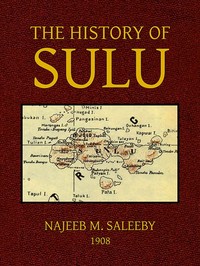
The History of Sulu
free to read
length
119,577 words
a few pages a day
~8 min
finished in
63 days
full read
8h 18m
At Folio's default of ten pages a day, you finish The History of Sulu in about 63 days — roughly 8 minutes of reading each morning.
The opening
the first pages of The History of Sulu, free
Appendix I. The pacification of Mindanao by Ronquillo 269 II. The pacification of Mindanao 275 III. The Moro raids of 1599 and 1600 279 IV. Gallinato's expedition to Jolo 283 V. Olaso's expedition in 1629 289 VI. Corcuera's campaign in Jolo 291 VII. Obando's report on the preparations to be undertaken to return Alimud Din to Sulu 305 VIII. Obando's report on the circumstances attending the attempt to return Alimud Din to Sulu 307 IX. Report on the occupation of Palawan and Balabak 313 X. A brief report on the expedition to take possession of Palawan 317 XI. The letter of the King of Spain to Sultan Israel 319 XII. Letter from the captain-general of the Philippines forwarding a copy of the treaty of peace, protection, and commerce with Sulu 321 XIII. Royal directions relative to commerce with Sulu, and the advisability of making Zamboanga a free port 325 XIV. Camba's report on the circumstances attending the treaty of 1836 and its bases 333 XV. Camba's report on commerce with Sulu and the advisability of making Zamboanga a free port 339 XVI. Communication from the governor of Zamboanga to the supreme government of the Philippines, relative to the treaty of Sir James Brooke with the Sultan of Sulu 345 XVII. Communication from the supreme government of the Philippines to the secretary of state, relative to the treaty of Sir James Brooke with the Sultan of Sulu 355 XVIII. Regulations relative to taxes and imposts on natives and immigrants in Sulu 359 XIX. The protocol of Sulu, of 1877, between Spain, Germany, and Great Britain 367 XX. The protocol of Sulu of 1885, between Spain, Germany, and Great Britain 371 XXI. Decree of the general government in regard to payment of tribute by Sulus 375 XXII. Royal communications relative to the rights of foreigners to the pearl fisheries of Sulu 377 XXIII. Royal directions relative to the treatment of foreigners engaged in pearl fishing in the Sulu waters 383 XXIV. La Torre's views on the policy that should be adopted in Mindanao and Sulu 385
Maps and Diagrams
Map I. The Sulu Archipelago Frontispiece Facing page-- II. Sulu Island 128 III. Sketch of Jolo before 1888 134 IV. Sketch of Jolo at the present time 134 Diagram 1. Sultans and royal datus of Sulu 158 2. Datus of Sulu not descended from Abu Bakr 158
PREFACE
The first object sought in the search for the Genealogy of Sulu was a knowledge of those significant historical events of Sulu which antedated the Spanish discovery and conquest of the Philippine Islands, the connection which those events might have had with the earlier history of the other islands and the light that they might throw upon the subject of prehistoric Malayan immigration to the Archipelago. The tarsila (genealogies) [1] of Mindanao show that events of considerable importance had occurred in the Archipelago, especially in the south, long before the Portuguese or the Spaniards reached Malaysia. Some tribes, such as the Samals, we were told, had emigrated from western Malaysia to the Sulu Archipelago and Mindanao, and indications were not wanting that probably other tribes, now inhabiting the Philippine Islands, came from the same place. Further, information was desired relative to the mohammedanization of Sulu and the possible connection that such a movement might have had with the introduction of Islam into Sumatra and Malacca.
The research so conducted was well rewarded. The history of Sulu was traced as far back as the early days of its oldest settlements, and the organization of the nation was followed back to the primitive communities out of which the Sulu nation has grown. Records of early Malayan expeditions and of communication between Sulu and Mindanao were traced to the earliest missionaries who reached these Islands by the way of Malacca, and through whom the sultanates of Mindanao and Sulu were organized on plans similar to those of Malacca and Palembang. A fuller account of the life history and work of these missionaries will be given in a later paper of this series. We here give only a narrative of the events in which they participated and the part they played in making the history of Sulu proper.
Many difficulties were encountered in the effort to secure an authentic copy of the Genealogy of Sulu. Several trips of 20 to 40 miles were made in small Moro sailing craft to visit datus who were said to have copies of this document. The Sulu authorities who had the manuscript or copies of it denied this fact from time to time, but after two years and a half of persistent endeavor and inquiry, the original manuscript was procured from the prime minister of the Sultan of Sulu, whose confidence was gained by a long period of intimate acquaintance and frequent communication. Soon after that, the Annals of Sulu (the Luntar) were obtained from the sultan and some facts of importance were learned and made use of in the course of this work. Diligent effort was further made to collect all interesting Sulu traditions and documents, and most of the best informed Sulus living were interviewed. Of these the author feels under special obligation to mention Sheikh Mustafa bin Ahmad, formerly prime minister to Sultan Harun; Hadji Butu, prime minister of the present Sultan of Sulu; Datu Pangiran; and Hadji Mohammed Tayib, one of the principal advisers of the present sultan.
Keep going from exactly here — Folio remembers your place and serves the next portion tomorrow.
continue reading The History of SuluAbout this free edition
The History of Sulu by Najeeb M. Saleeby (1870-) is free to read in full. Folio serves it in daily portions you can actually finish, tracks your streak and reading position across devices, and reads every page aloud with a built-in narrator. The text comes from Project Gutenberg.
More like The History of Sulu
The History of the Peloponnesian War
Folio
The History of the Peloponnesian War
Thucydides
The History of Herodotus
Folio
The History of Herodotus
Herodotus
The Gallic Wars
Folio
The Gallic Wars
Julius Caesar
Anabasis
Folio
Anabasis
Xenophon
The Lives of the Twelve Caesars
Folio
The Lives of the Twelve Caesars
Suetonius
Germania
Folio
Germania
Tacitus

The History of the Decline and Fall of the Roman Empire
Edward Gibbon
The Travels of Marco Polo
Marco Polo