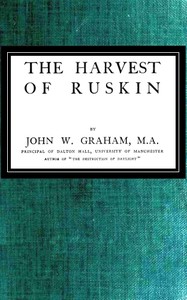
The Harvest of Ruskin
free to read
length
53,765 words
a few pages a day
~8 min
finished in
29 days
full read
3h 44m
At Folio's default of ten pages a day, you finish The Harvest of Ruskin in about 29 days — roughly 8 minutes of reading each morning.
The opening
the first pages of The Harvest of Ruskin, free
This book is concerned with Ruskin’s teaching in the departments of Religion and Economics only, including his social reforms and educational schemes. It leaves out all his work on Art and in Natural History and Mineralogy. His thoughts on Beauty in Landscape are treated only so far as that Beauty is damaged by Industrialism or by War. Nor has any attempt been made to produce an analysis of his literary style or styles. The long extracts which the plan of the book requires, however, afford sufficient examples of his artistry in words.
My aim is to give a critical estimate in a reverent spirit of Ruskin’s teaching in these two departments, and to apply it to the needs of our own time.
The development of Ruskin’s religious faith and its final outcome have not, I believe, been fully worked out before, and the reconciliation which I have attempted in the region of Economics is long overdue. These parts of the book have been delivered as lectures in past years under the Manchester and Liverpool University Extension Committees, at Summer Schools, and elsewhere.
I am indebted to Ruskin’s literary executors for permission to quote freely from his works.
J. W. G.
DALTON HALL, MANCHESTER.
CONTENTS
CHAPTER PAGE
I. THE SIGNS OF A PROPHET 9
II. THE PILGRIM’S WAY 26
III. TO WHAT FOLD? 55
IV. RUSKIN AND MILL: A RECONCILIATION 78
V. RUSKIN’S RECONSTRUCTION 120
VI. RUSKIN’S ECONOMICS TO-DAY 151
VII. USURY 185
VIII. WAR 203
IX. MACHINERY 222
EPILOGUE 259
INDEX 267
The Harvest of Ruskin
CHAPTER I
THE SIGNS OF A PROPHET
Now that one hundred years have gone by since their one precious boy was born in London to a Scottish wine merchant and his wife, it may be well to ask how much of Ruskin’s teaching has proved to be chaff which the wind driveth away, and how much has been precious seed. Ruskin is just now suffering from the time of comparative neglect which intervenes between an author’s contemporaries and posterity, the years when the immediate appropriateness of his message may have lapsed, when it is no longer fresh and startling, but its permanent value has not yet been settled by the verdict of several generations. All or nearly all the great Victorians are in like case.
Ruskin’s art criticism is, as a matter of fact, not only ignored but resolutely rejected nowadays among critical writers. He loved beauty and charm in subject; he rejected scenes of horror and torture, and also subjects of mere Dutch commonplace. He loved delicate and accurately minute drawing, and the realistic detail of the Preraphælites. He desired that a tree in a picture should be recognized as an oak or a birch; and he loved above all fine drawing of mosses, leaves, and peacocks’ wings. This is the day of impressionism, super-impressionism and impression of impressionism, and so on, through ever greater abandonment of drawing and significance, to cubism, futurism and other weird follies. I am not wishful to dogmatize on these matters; I incline to the sage and wonderful conclusion that all styles are good provided they are good styles; that conscientiousness in the portrayal of what the artist really sees will not lead him astray; that originality, or at any rate a marked individual gift, is a necessity; and that there is no one orthodox school. As in everything else, the letter killeth, convention blocks progress, and slovenliness includes a multitude of sins.
Keep going from exactly here — Folio remembers your place and serves the next portion tomorrow.
continue reading The Harvest of RuskinAbout this free edition
The Harvest of Ruskin by John W. Graham (1859-1932) is free to read in full. Folio serves it in daily portions you can actually finish, tracks your streak and reading position across devices, and reads every page aloud with a built-in narrator. The text comes from Project Gutenberg.
More like The Harvest of Ruskin
Meditations
Folio
Meditations
Marcus Aurelius
The Enchiridion
Epictetus

Thus Spake Zarathustra
Friedrich Nietzsche
Beyond Good and Evil
Folio
Beyond Good and Evil
Friedrich Nietzsche
The Genealogy of Morals
Folio
The Genealogy of Morals
Friedrich Nietzsche
The Republic
Folio
The Republic
Plato
Apology
Folio
Apology
Plato
Crito
Folio
Crito
Plato