The Giant Raft
Folio
The Giant Raft
first published 1881 · free to read
length
94,652 words
a few pages a day
~8 min
finished in
50 days
full read
6h 34m
At Folio's default of ten pages a day, you finish The Giant Raft in about 50 days — roughly 8 minutes of reading each morning.
The opening
the first pages of The Giant Raft, free
_“P h y j s l y d d q f d z x g a s g z z q q e h x g k f n d r x u j u g I o c y t d x v k s b x h h u y p o h d v y r y m h u h p u y d k j o x p h e t o z l s l e t n p m v f f o v p d p a j x h y y n o j y g g a y m e q y n f u q l n m v l y f g s u z m q I z t l b q q y u g s q e u b v n r c r e d g r u z b l r m x y u h q h p z d r r g c r o h e p q x u f I v v r p l p h o n t h v d d q f h q s n t z h h h n f e p m q k y u u e x k t o g z g k y u u m f v I j d q d p z j q s y k r p l x h x q r y m v k l o h h h o t o z v d k s p p s u v j h d.”_
The man who held in his hand the document of which this strange assemblage of letters formed the concluding paragraph remained for some moments lost in thought.
It contained about a hundred of these lines, with the letters at even distances, and undivided into words. It seemed to have been written many years before, and time had already laid his tawny finger on the sheet of good stout paper which was covered with the hieroglyphics.
On what principle had these letters been arranged? He who held the paper was alone able to tell. With such cipher language it is as with the locks of some of our iron safes--in either case the protection is the same. The combinations which they lead to can be counted by millions, and no calculator’s life would suffice to express them. Some particular “word” has to be known before the lock of the safe will act, and some “cipher” is necessary before that cryptogram can be read.
He who had just reperused the document was but a simple “captain of the woods.” Under the name of “Capitaes do Mato” are known in Brazil those individuals who are engaged in the recapture of fugitive slaves. The institution dates from 1722. At that period anti-slavery ideas had entered the minds of a few philanthropists, and more than a century had to elapse before the mass of the people grasped and applied them. That freedom was a right, that the very first of the natural rights of man was to be free and to belong only to himself, would seem to be self-evident, and yet thousands of years had to pass before the glorious thought was generally accepted, and the nations of the earth had the courage to proclaim it.
In 1852, the year in which our story opens, there were still slaves in Brazil, and as a natural consequence, captains of the woods to pursue them. For certain reasons of political economy the hour of general emancipation had been delayed, but the black had at this date the right to ransom himself, the children which were born to him were born free. The day was not far distant when the magnificent country, into which could be put three-quarters of the continent of Europe, would no longer count a single slave among its ten millions of inhabitants.
The occupation of the captains of the woods was doomed, and at the period we speak of the advantages obtainable from the capture of fugitives were rapidly diminishing. While, however, the calling continued sufficiently profitable, the captains of the woods formed a peculiar class of adventurers, principally composed of freedmen and deserters--of not very enviable reputation. The slave hunters in fact belonged to the dregs of society, and we shall not be far wrong in assuming that the man with the cryptogram was a fitting comrade for his fellow “capitaes do mato.” Torres--for that was his name--unlike the majority of his companions, was neither half-breed, Indian, nor negro. He was a white of Brazilian origin, and had received a better education than befitted his present condition. One of those unclassed men who are found so frequently in the distant countries of the New World, at a time when the Brazilian law still excluded mulattoes and others of mixed blood from certain employments, it was evident that if such exclusion had affected him, it had done so on account of his worthless character, and not because of his birth.
Keep going from exactly here — Folio remembers your place and serves the next portion tomorrow.
continue reading The Giant RaftAbout this free edition
The Giant Raft by Jules Verne (1828-1905) is free to read in full. Folio serves it in daily portions you can actually finish, tracks your streak and reading position across devices, and reads every page aloud with a built-in narrator. The text comes from Project Gutenberg.
More like The Giant Raft
Godfrey Morgan
Folio
Godfrey Morgan
Jules Verne
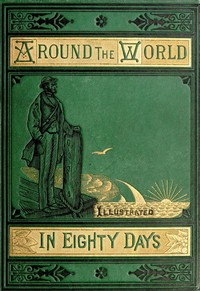
Around the World in Eighty Days
Jules Verne
Twenty Thousand Leagues Under the Sea
Folio
Twenty Thousand Leagues Under the Sea
Jules Verne
A Journey to the Centre of the Earth
Folio
A Journey to the Centre of the Earth
Jules Verne
The Mysterious Island
Folio
The Mysterious Island
Jules Verne
Michael Strogoff
Folio
Michael Strogoff
Jules Verne
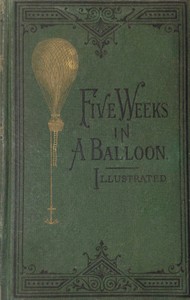
Five Weeks in a Balloon
Jules Verne
The Fur Country
Folio
The Fur Country
Jules Verne